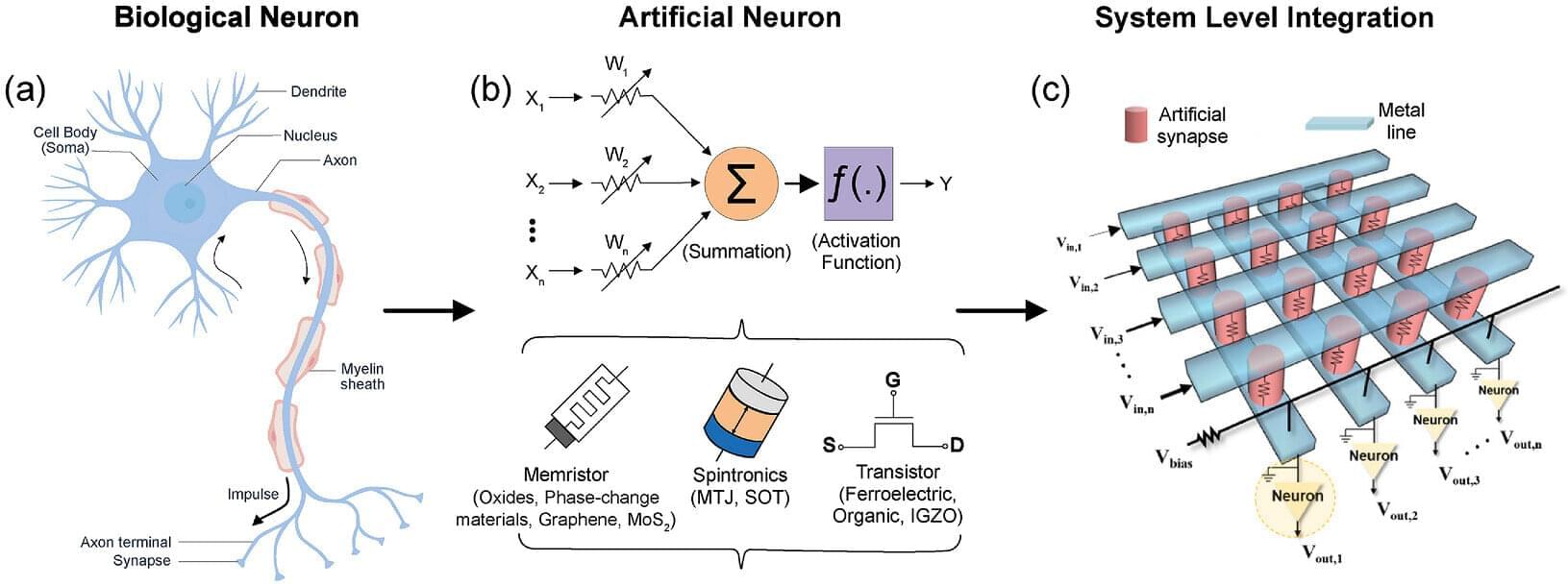
With artificial intelligence (AI) data centers consuming electricity at a growing rate, identifying a sustainable computing solution to offset these massive community and environmental disruptors is proving critical.
Researchers from the University of Ottawa, Columbia University and Hanyang University believe building brain-inspired computing systems could provide the answer to this global conundrum, with small, fast, energy-efficient and scalable artificial neurons able to support the large-scale computing systems that are now regularly dotting our landscapes.
“The materials and architectures described in this review represent a fundamentally different way to process information. By operating more like a human brain than a traditional processor, these emerging technologies will lead to physical devices that are dramatically more energy-efficient, faster and adaptive,” explained lead author Dr. Kannan Udaya Mohanan, a postdoctoral fellow in professor Chang-Hyun Kim’s research group at uOttawa.