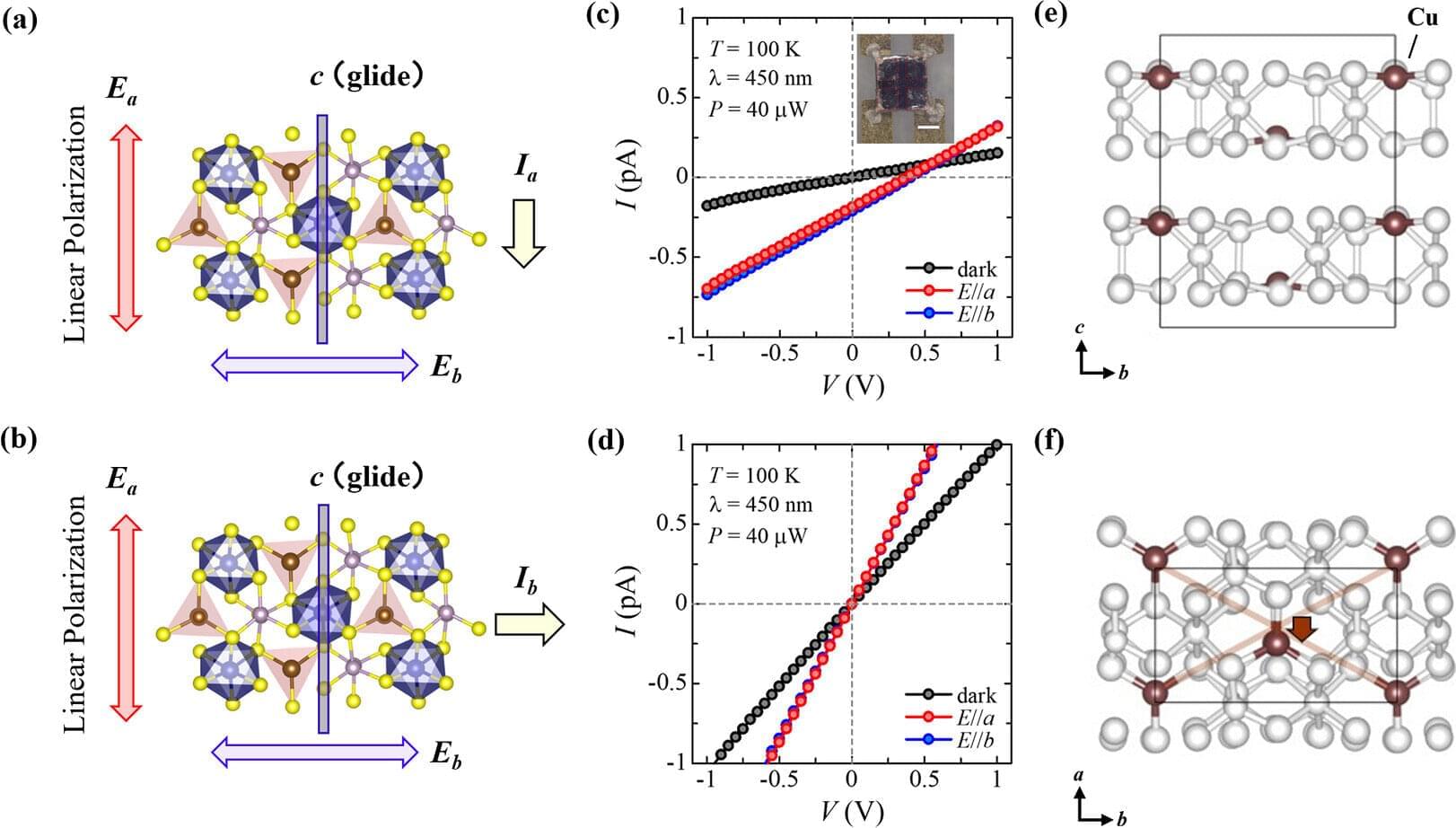
The bulk photovoltaic effect (BPVE), a photoelectric effect that generates photocurrent without a p–n junction, can persist even when a material’s average crystal structure remains centrosymmetric, a study from Institute of Science Tokyo has found. Researchers demonstrated this in CuCrP2S6, a van der Waals material that transitions from a noncentrosymmetric to a centrosymmetric average structure. The finding challenges the conventional view of BPVE and suggests a new strategy for enhancing photoelectric conversion.
Conventional solar cells generate photocurrent by separating and transporting light-generated charge carriers, typically through structures such as p–n junctions. This approach has a fundamental theoretical efficiency limit, known as the Shockley–Queisser limit. For an ideal single-junction silicon solar cell, this limit is about 33%.
The bulk photovoltaic effect (BPVE) offers an alternative way of generating photocurrent that is not subject to the same Shockley–Queisser limit. In BPVE, light interacts with a material to generate photocurrent without requiring a p–n junction. BPVE has traditionally been associated with noncentrosymmetric crystal structures.