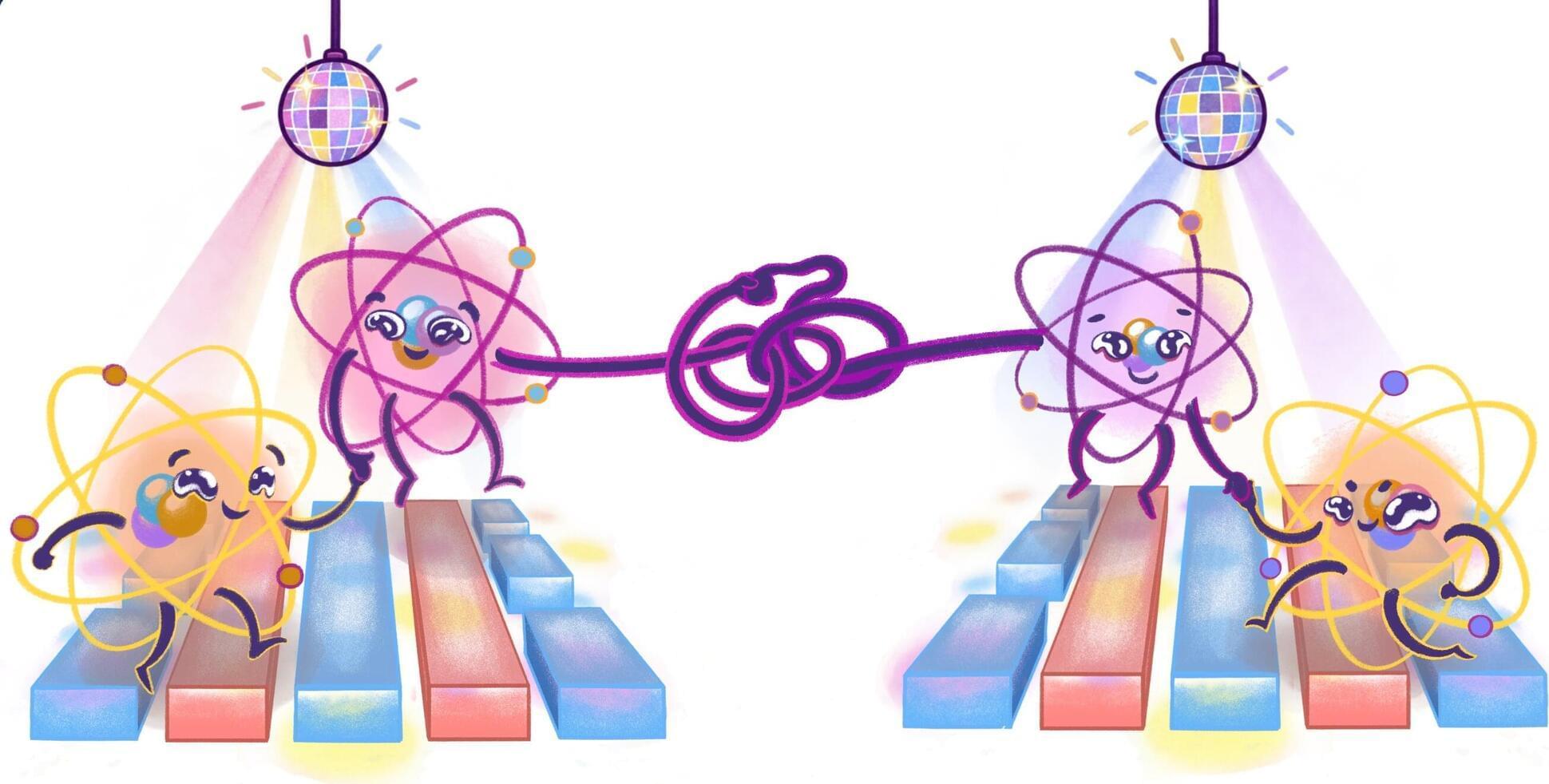
Quantum networks, systems that connect devices and allow them to exchange information encoded in the quantum states of particles, could enable more secure communications. To build these networks, physicists need to devise strategies that allow distant particles to share quantum states, preserving them long enough to perform calculations or enable communication between devices.
Researchers at the University of Oxford recently realized a quantum network with four qubits (i.e., units of quantum information) encoded in trapped ions distributed between two locations linked by optical fibers. This network, outlined in a paper published in Physical Review Letters, relied on electrically charged atoms held in place by electromagnetic fields, also known as trapped ions.
“The work grew out of our efforts to build a quantum network in which each node can do more than create an entangled link to another node,” Dr. Gabriel Araneda, co-senior author of the paper, told Phys.org.