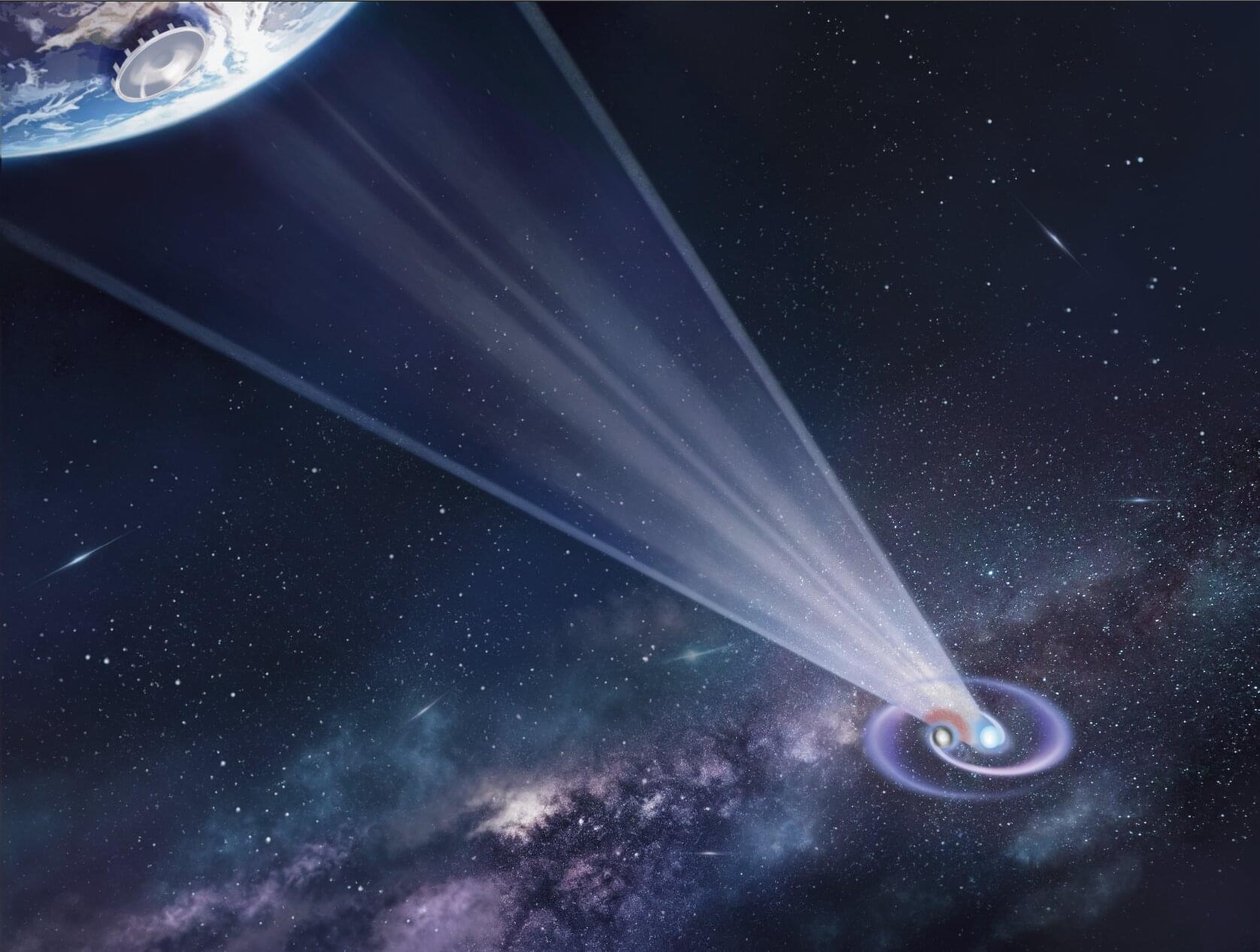
Neutron stars, the extremely dense remains of massive stars that exploded at the end of their lives, are widely studied astrophysical objects. Some of these stars, known as pulsars, spin and send out beams of radio waves, making them appear to pulse as the beams sweep past Earth.
According to Einstein’s theory of general relativity, orbiting neutron stars should emit ripples in spacetime known as gravitational waves. The resulting loss of energy should gradually draw pairs of neutron stars closer together, shortening the time they take to complete each orbit.
Researchers at the Chinese Academy of Sciences, the State Key Laboratory of Radio Astronomy and Technology in Beijing and other academic institutions in China set out to test this prediction by studying PSR J1856–0039, a double neutron star (DNS) system discovered using the Five-hundred-meter Aperture Spherical radio Telescope (FAST) in China.