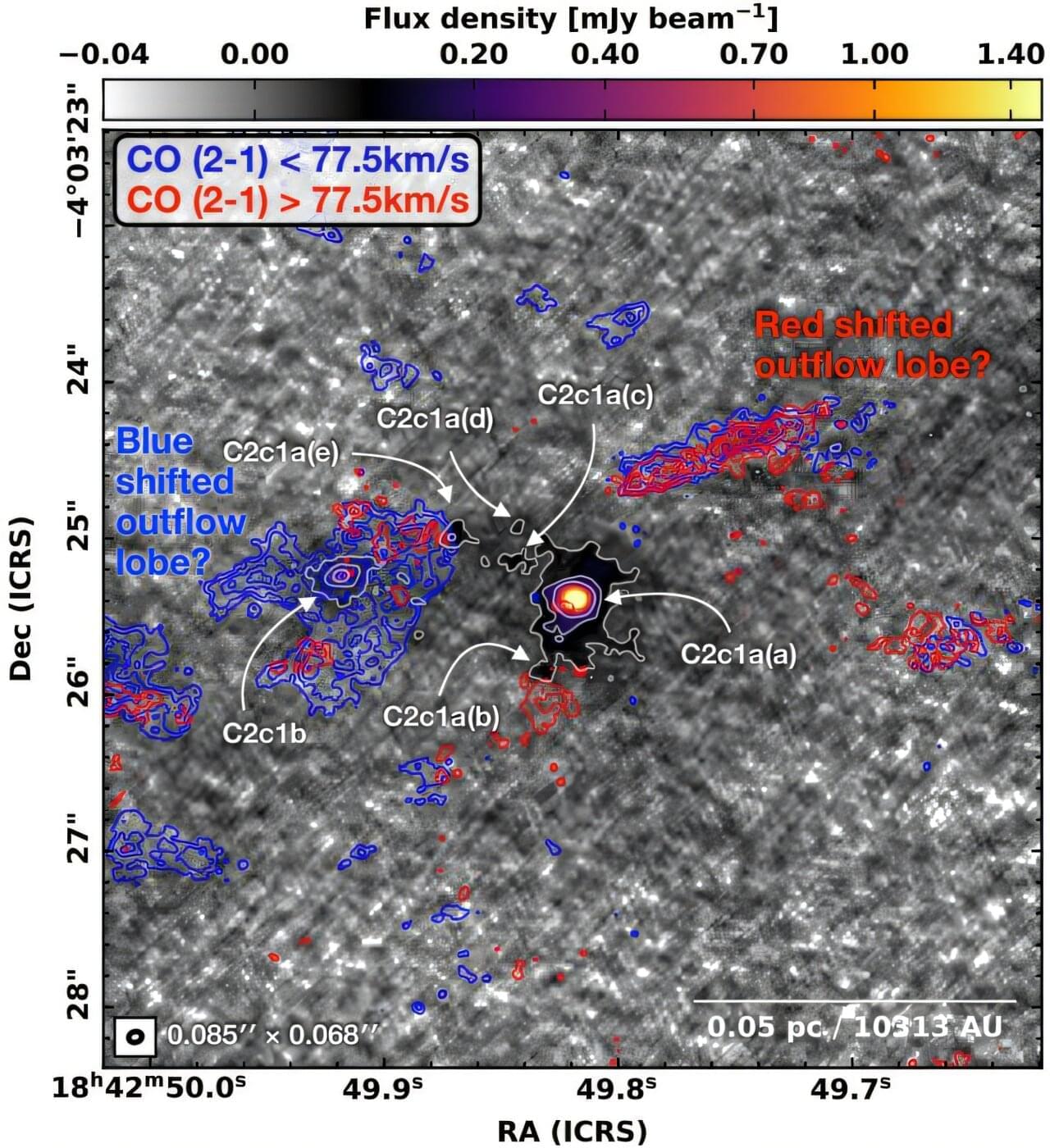
Astronomers identified an exceptionally tiny core that may represent an early stage in the formation of a massive star. Located in an infrared-dark area called Dragon Cloud, the core is nicknamed the “dragon egg.” The paper, accepted for publication in Astronomy & Astrophysics, was posted to the arXiv preprint server on Oct. 5.
How giant stars, with masses eight times greater than the sun, form is still a matter of debate in the scientific community. There are two main ideas. One says that a dense cloud of gas first condenses into a massive “pre-stellar” core, which then collapses to form a single giant star. Another says the star begins small and grows by pulling in material from the larger clump around it.
Researchers think that if they directly observe a compact, massive yet young concentration of mass, they will be able to lean toward one of these ideas. Such cores, however, are hard to detect, and if they are found, their interpretations are sometimes complicated by nearby star formation and stellar activity.