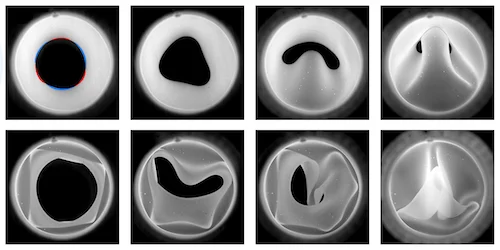
A simplified model of the heart’s mitral valve shows that flow fluctuations can cause a soft valve to close at about one-tenth the pressure required under steady flow.
We are all familiar with the rigid valves that control the flow of water through the heating system or to kitchen taps. Valves are also ubiquitous in nature—although they are often soft rather than rigid. In plants and fungi, for example, soft valves passively regulate fluid flow through internal transport networks, without the need for active control [1]. Their compliance—the extent to which these structures deform under pressure—enables them to alter the geometry of fluidic channels, a behavior that lies at the heart of soft hydraulics [2]. Flexible valves are also found in the cardiovascular system. The mitral valve in the heart, for example, deforms and closes to prevent the backward flow of blood. Cardiovascular valves operate in larger channels and under faster flows than their counterparts in plants and fungi.