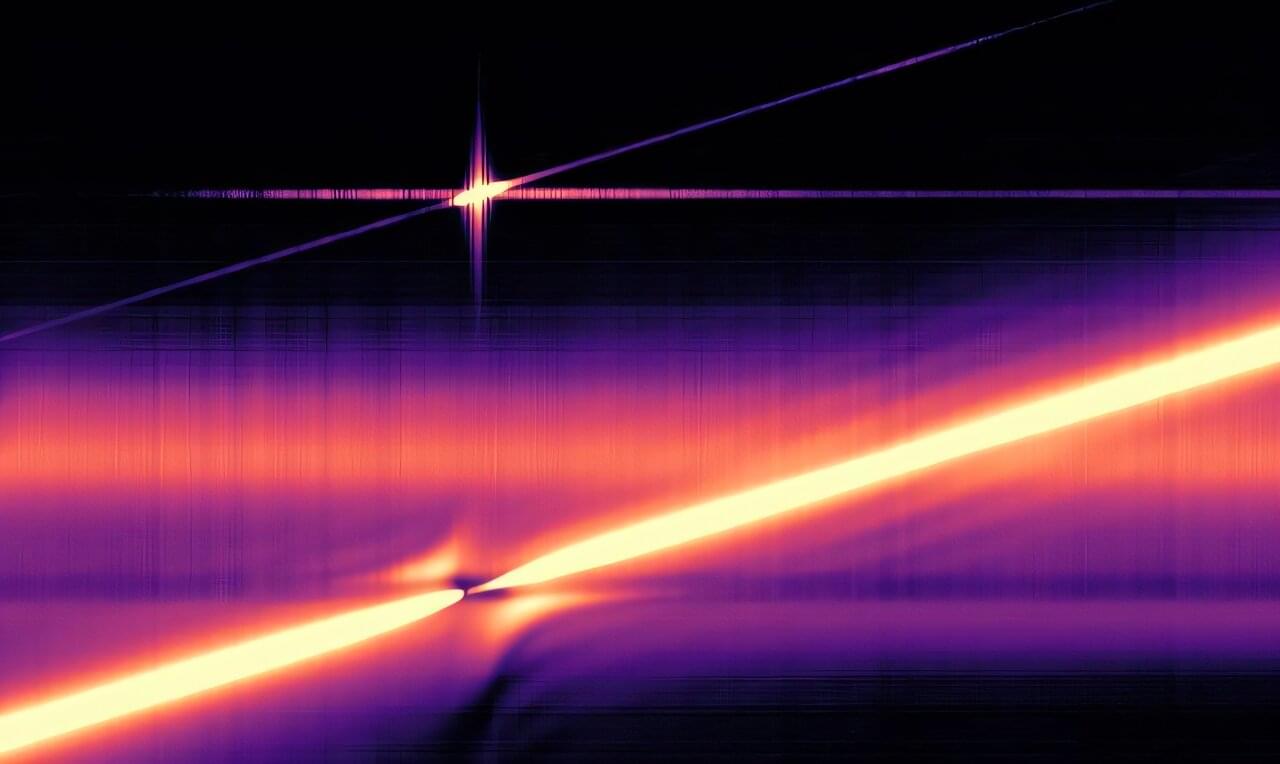
For the first time, scientists have achieved strong coupling between light and long-lived acoustic vibrations in an optical fiber. Optical fibers are used in both classical telecommunications and quantum communication and could serve not only as connections between computing nodes but also as quantum processors themselves in the future. The results, published in Nature Physics, pave the way for new technologies in quantum signal processing.
Mechanical and acoustic vibrations can be used to convert signals across various frequency ranges, from optical frequencies (terahertz) to microwaves (gigahertz) and even lower frequencies (megahertz or kilohertz). For instance, this capability is essential to connect multiple quantum computers operating at gigahertz frequencies via optical links. Furthermore, acoustic waves propagate at speeds significantly lower than the speed of light. So, they provide a medium capable of transporting slowly moving information—which is of great interest for data storage and the temporary buffering of information.
However, to utilize one of these processing capabilities for quantum information via mechanical vibrations, one prerequisite is needed: the strong coupling regime. This regime ensures that quantum information is exchanged before it is lost due to losses and decoherence. Decoherence describes the state in which the waves no longer oscillate in unison. In the strong coupling regime, quantum information can be processed more quickly—faster than the rate at which noise enters the system—without losing quantum properties.