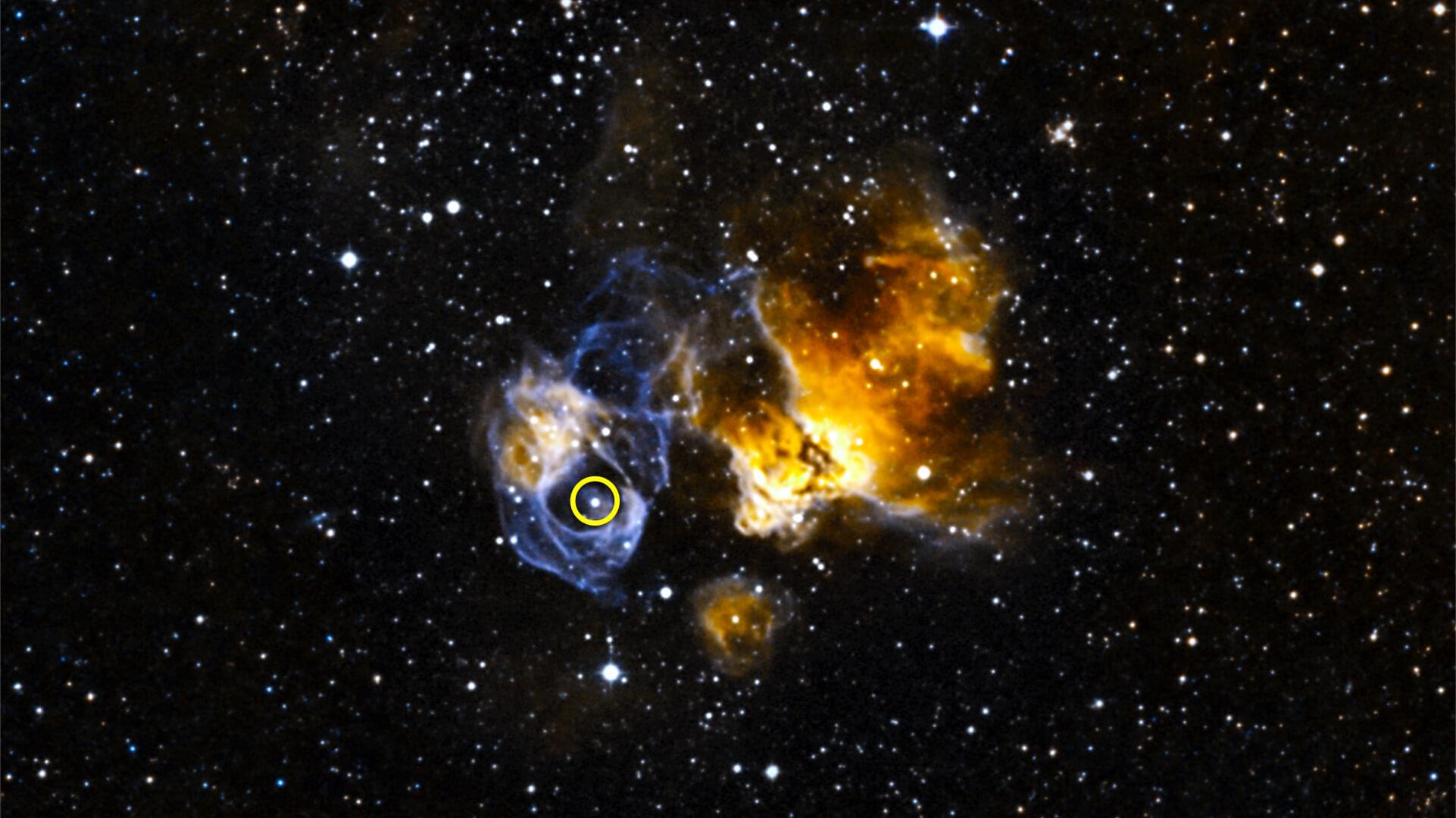
In 2016, a binary star system emitting unusually strong gamma rays was discovered in our galactic neighborhood. Now, astronomers have found the smoking gun, or rather, a smoking trail of cool molecular gas that suggests jets emanating from a microquasar—one of the few known outside the Milky Way—are responsible.
Unlike the Milky Way, which shrouds objects behind dust when looking toward the galactic core, the Large Magellanic Cloud (LMC), a dwarf satellite galaxy to our own, offers unhindered views of interesting and relatively nearby astrophysical phenomena.
LMC P3 is one such stellar puzzle. It is the most luminous gamma-ray binary star system, composed of a compact object—either a black hole or a neutron star—alongside a massive star that is more than 30 times heavier than the sun. The two stars take roughly 10 days to orbit each other.