As governments prepare to gather in Yerevan, Armenia, this week for the U.N. Biodiversity Conference (COP17), new research identifies 13% of Earth’s land area as hotspots for biodiversity conservation, highlighting where conservation efforts are most urgently needed.
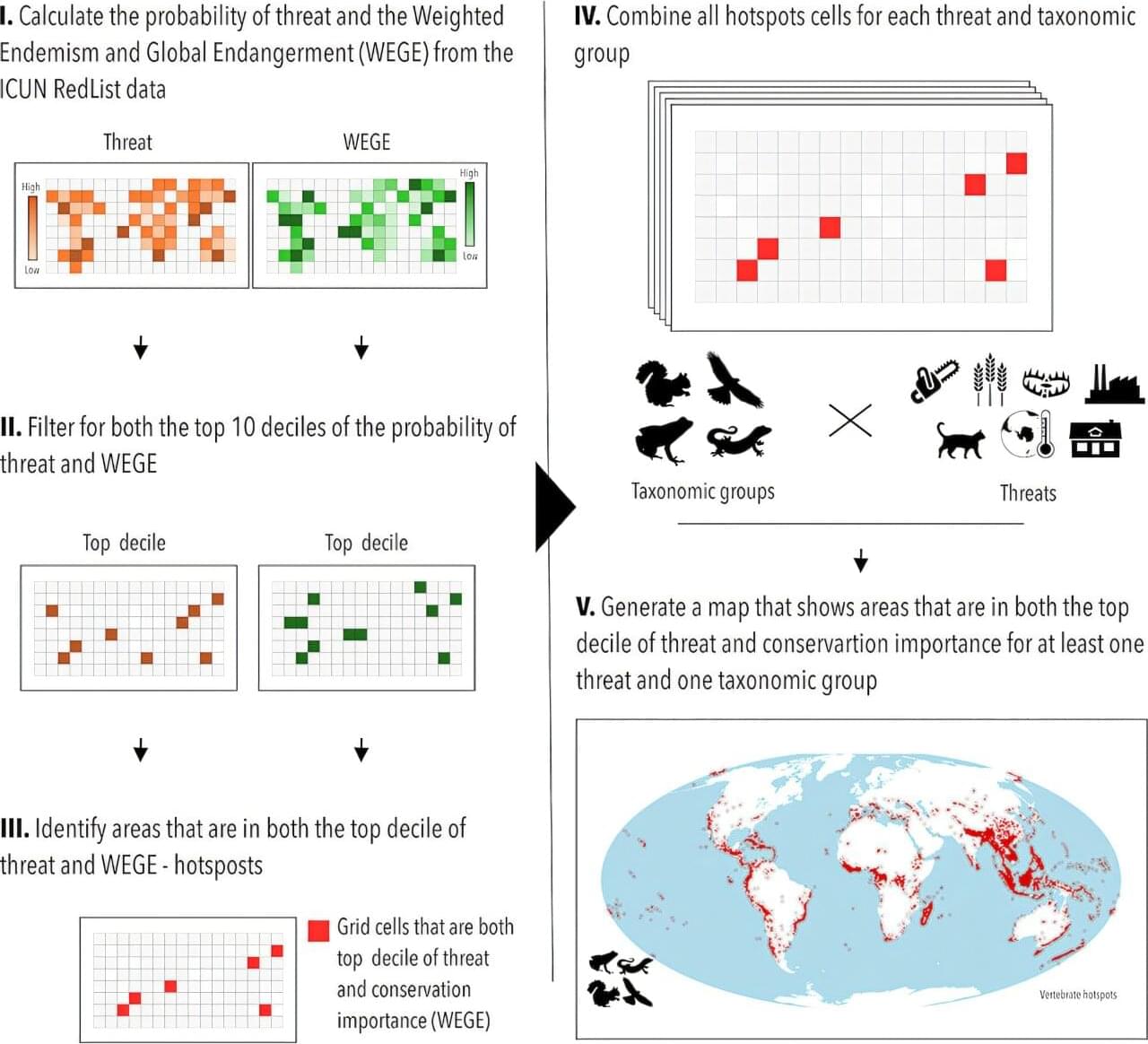
In their study published in the journal One Earth, an international team of researchers introduces a transparent and reproducible framework for mapping vertebrate conservation hotspots across Earth’s terrestrial surface. By analyzing data for 33,604 species of terrestrial vertebrates from the IUCN Red List, the authors combine information on where threatened and range-restricted species concentrate with key human-driven threats such as logging, agriculture, urbanization and invasive species.
Approximately 13% of the global land area is identified as a vertebrate hotspot, with many of these areas concentrated in tropical regions and broadleaf forests. Furthermore, these critical areas are home to over a third of the global human population, emphasizing the need for conservation approaches tailored to local conditions that protect biodiversity while also supporting people’s well-being.