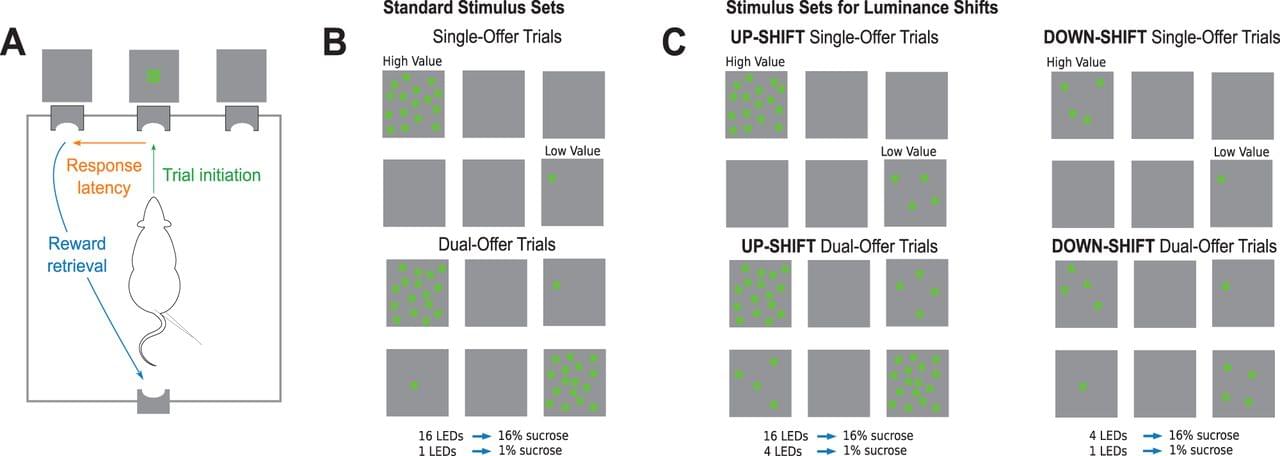
Studies of visual discrimination in rodents can confound the effects of cue salience with reward value making it difficult to determine which factor guides choice behavior. We examined this issue by testing how changes in relative salience affect decision dynamics in rats (nine females and five males) performing a two-alternative forced-choice task with visual cues associated with high or low sucrose rewards. After initial training with high-and low-luminance cues, we introduced a novel cue of intermediate luminance as a “luminance shift” test. The intermediate luminance cue substituted for either the brighter or dimmer cue and had the same reward value as the replaced cue. We found that while rats maintained a preference for the higher-value option, the introduction of a perceptually more similar cue reduced choice preference and eliminated latency differences compared with baseline.