Quantum materials do things ordinary materials cannot. They carry current without any loss, or conduct only along their outer edge while the inside insulates. Future quantum computers and quantum sensors will run on materials like these. To improve them, researchers need to see exactly where currents and magnetic fields run at the nanoscale.
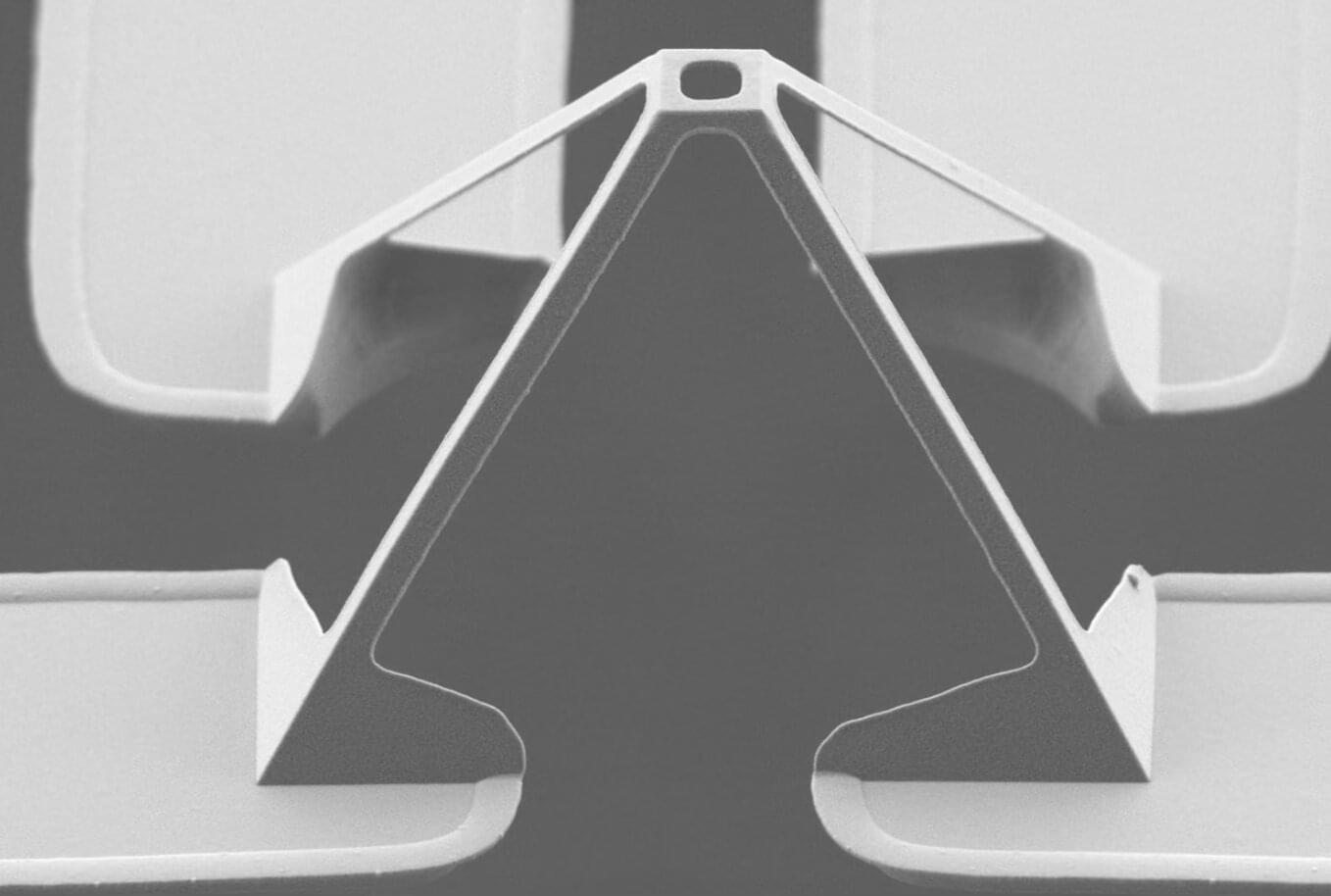
A SQUID, a superconducting ring that registers even the smallest magnetic changes, is sensitive enough for the task. The problem is distance. Magnetic fields weaken quickly with distance, so the sensor must get close to the material. If the ring lies flat in the plane of a chip, the rest of the chip holds it several micrometers away from the material. That is where the detail is lost. The University of Twente has worked on scanning SQUID microscopy for years, mapping the magnetism of a surface.
“That is why we put the sensor on a pyramid,” says Hans Hilgenkamp. “On top of that pyramid the sensor can be brought right up to the material we want to look at, with nothing else in the way. That lets us image magnetism at the scale where quantum materials do their work.” This opens the door to new materials with unusual functionality. Within the Gravitation program QuMat, Twente builds instruments that it and its partners can use to measure quantum materials and develop them further.