While lithium-ion batteries (LIBs) remain the most widely used rechargeable batteries worldwide, energy engineers have been testing various alternatives with different underlying chemistries. These include lithium-sulfur batteries, which store and release energy by moving lithium ions between two electrodes on opposite sides of a cell, while sulfur undergoes reactions in the cathode (i.e., positive electrode).
Lithium-sulfur batteries could offer several advantages, including high energy densities and lower production costs, because sulfur is abundant and can store significant charge relative to its mass. Despite their potential, these batteries often exhibit low operating voltages (i.e., the pressure driving current), slow electron-transfer reactions, and energy losses caused by the migration of sulfur compounds between electrodes.
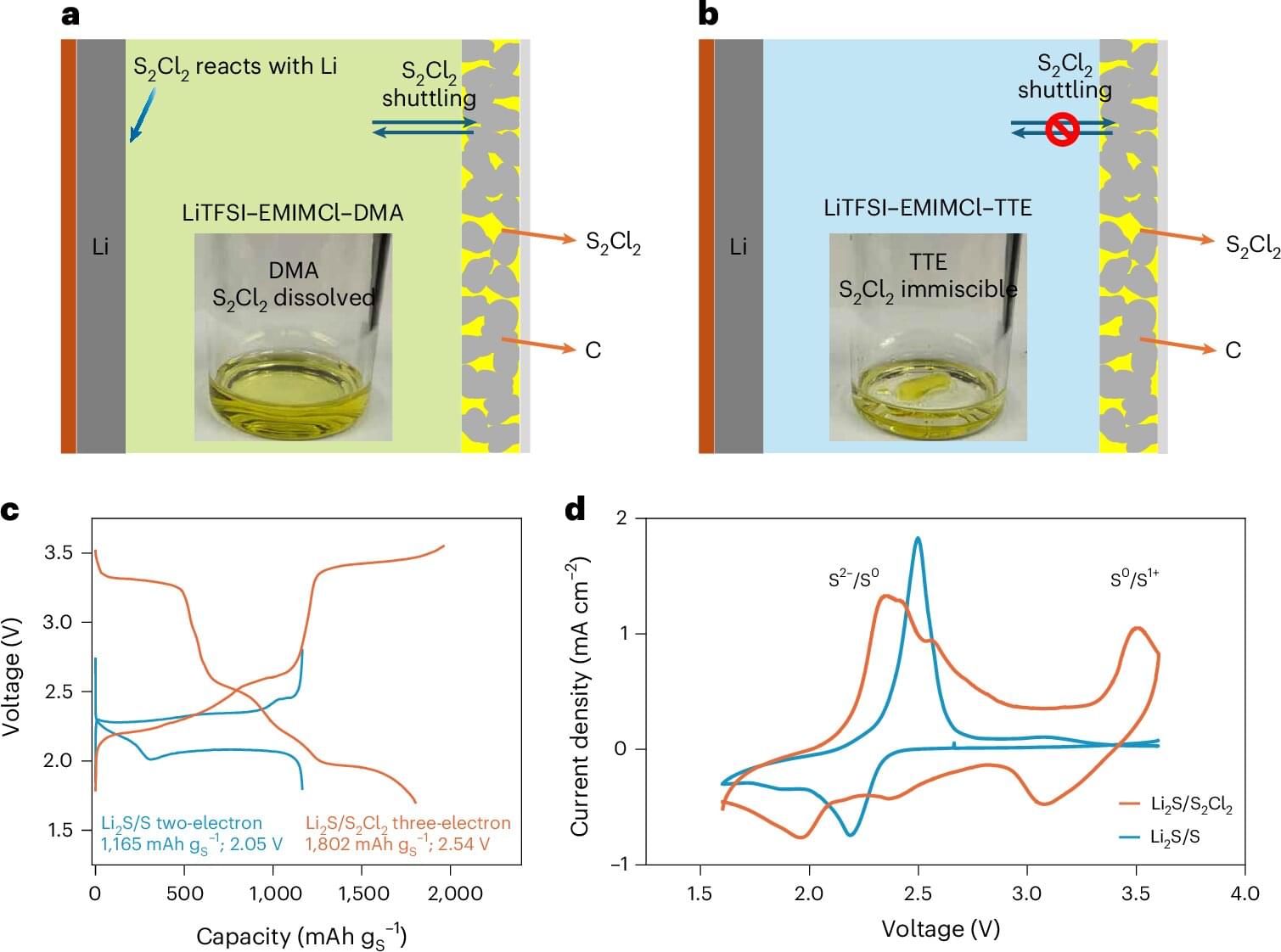
Researchers at the University of Maryland, Vanderbilt University, the Brookhaven National Laboratory, and other institutes recently introduced a new ionic liquid electrolyte that could improve the performance of lithium-sulfur batteries. This electrolyte, presented in a paper published in Nature Energy, was found to increase both the voltage and energy storage of lithium-sulfur batteries.