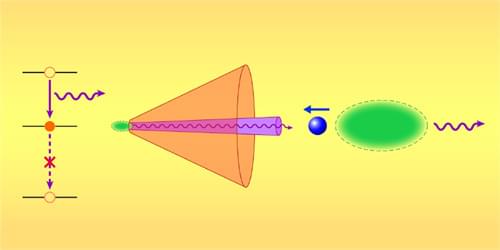
Two studies find that fundamental quantum constraints rule out a previously proposed neutrino-laser scheme.
One of the most striking demonstrations of collective quantum behavior is superradiance. When photons emitted by many particles carry no information about which particle produced them, the different emission pathways interfere constructively, and the ensemble radiates far more intensely than independent emitters would. Last year, scientists proposed that this principle could extend from photons to neutrinos, potentially enabling the first neutrino laser (see Viewpoint: Envisioning a Neutrino Laser) [1]. The idea was especially appealing because neutrinos are otherwise extremely difficult to control and detect, owing to their weak interactions with matter. Now Wolfgang Ketterle and his colleagues at MIT have demonstrated that this vision of neutrino superradiance runs up against fundamental constraints—ones imposed not by engineering challenges but by quantum mechanics itself [2, 3].
Superradiance is a collective enhancement of spontaneous emission [4]. An isolated atom emits at its natural rate γ so N independent atoms radiate at a total rate N γ But when all the atoms radiate into the same mode, constructive interference of the different emission pathways can cause the maximum emission rate to scale as N2 γ This superradiant regime can occur when the atoms occupy a region much smaller than the radiation’s wavelength or when an optical cavity forces them to couple to a common mode [5–7]. Such collective emission can also arise in extended atomic systems, where it becomes directional and is shaped by propagation effects. This extended-ensemble superradiance has been observed in free space [8] and in waveguides [9].