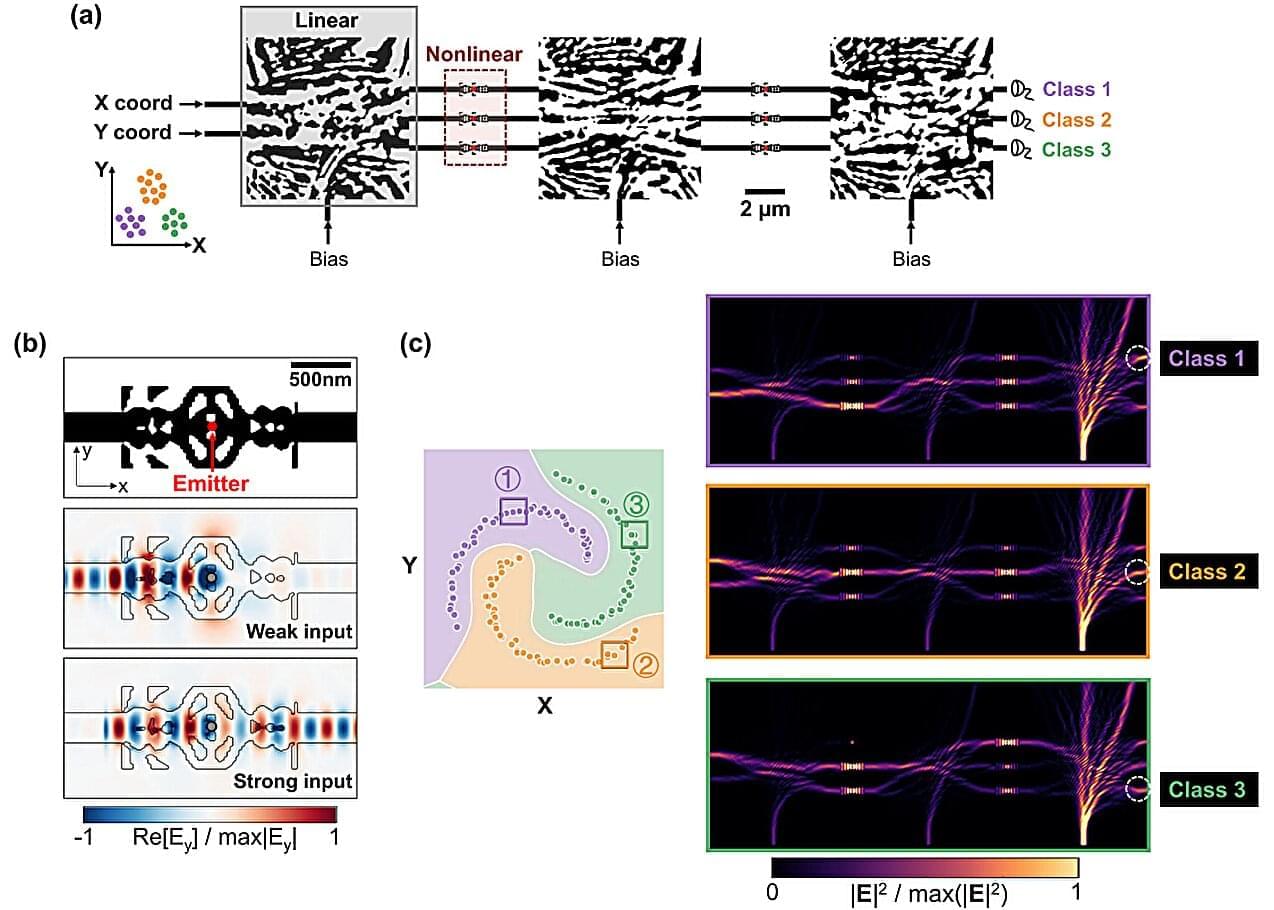
Engineers at the University of Wisconsin–Madison have designed a new type of quantum nanostructure that could enable optical neural networks. This emerging technology has the potential to make artificial intelligence systems, like large language models and image generation, faster and significantly more energy efficient.
The research, led by electrical and computer engineering Ph.D. students Qingyi Zhou and Jungmin Kim, computer science Ph.D. student Yutian Tao, and Zongfu Yu, a professor of electrical and computer engineering, was published in the journal Nature Communications on Aug. 27.
Many of the most popular AI systems are based on deep neural networks, multilayer systems that mimic the interconnectedness of the human brain. As those systems scale in size and complexity, their energy consumption also increases. That’s one factor in recent concerns about AI energy use and data center construction.