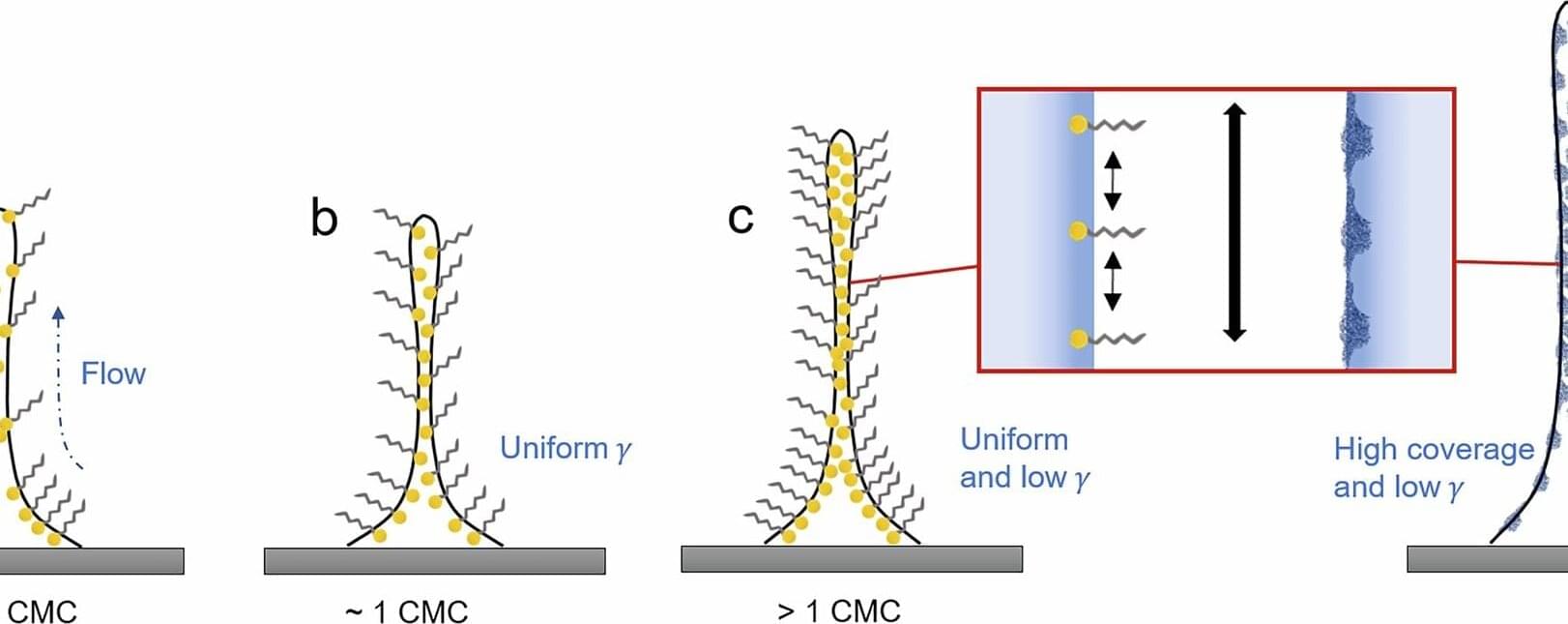
Tiny, soft polymer particles—known as microgels—can help to stabilize extremely thin liquid jets. How this works is the finding of a study led by researchers at TU Darmstadt, which has been published in Nature Communications. The findings could be of interest for the development of needle-free medical injection systems.
Microgels are soft polymer particles less than one micrometer in size. They can adsorb at the interface between air and water, where they reduce the surface tension of the liquid. In this respect, their effect is similar to that of conventional surface-active components—so-called surfactants—such as those often found in soap, dishwashing liquid or detergent. However, unlike many conventional surfactants, the microgels used in the study are nontoxic, and their interaction mechanism with the liquid differs significantly.
For their experiments, the scientists generated extremely thin jets of water using surface acoustic waves. A drop of water containing the microgels was used for this purpose. A specially manufactured chip generated the waves at a frequency of around 64 MHz, producing a liquid jet approximately 200 micrometers in diameter from the drop. A high-speed camera recorded the jet formation and extension.