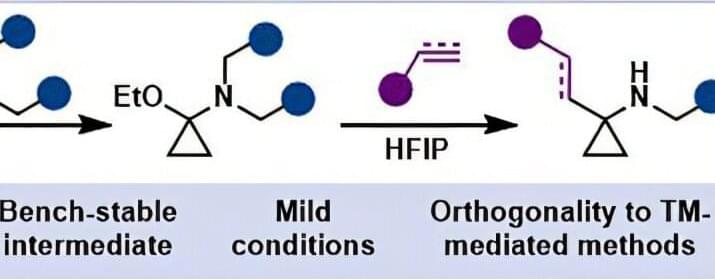
Cyclopropanes are organic chemistry’s smallest rings. Three carbon atoms are joined in a triangle, creating a compact and unusually strained structure. Despite—or partly because of—this unusual geometry, cyclopropanes are found in many biologically active natural products and have important applications in medicines and drug discovery, from antidepressants to antibiotics and antiviral research.
Connect these carbon triangles to an amine, a functional group with a nitrogen at its center, and you get aminocyclopropanes. They are of particular interest in pharmaceutical research because they can be used to replace another substructure commonly found in drug molecules: α,α-gem-dimethylamines (compounds in which the aminocyclopropane’s triangle is “opened” by disconnecting one edge).
Such molecular substitutes that resemble an existing part of a drug but can alter important properties, such as biological activity and metabolic stability, are referred to as bioisosteres and have shown beneficial effects in countless cases.