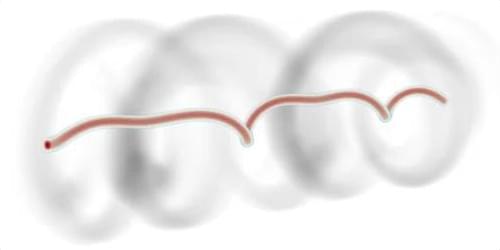
A tabletop experiment using a classical water vortex supports a decades-old theory describing the decay of turbulence in quantum fluids.
When you pull the plug at the end of a relaxing bath, a vortex forms as water drains through the plughole. If you watch carefully, the slender whirlpool may begin to wobble, with helical, corkscrew-like disturbances traveling along its length. In 1880, William Thomson, who later became Lord Kelvin, showed mathematically that a straight vortex filament can support such helical waves [1]. Today, Kelvin waves are thought to hold the key to one of the outstanding puzzles of quantum turbulence: how the kinetic energy of an agitated quantum fluid is ultimately dissipated. Now Eric Falcon of Paris Cité University and his colleagues have directly observed Kelvin-wave turbulence using a vortex no more exotic than one found in a bathtub [2].
Kelvin waves are particularly important in superfluids, ultracold atomic gases, and the interiors of neutron stars. Rather than being spread throughout the fluid, superfluid vorticity is confined to thin, line-like topological defects, each carrying a fixed quantum of circulation (Fig. 1) [3]. A tangle of these so-called quantum vortices forms quantum turbulence—“superfluid spaghetti”—first envisaged by Richard Feynman in the 1950s [4]. This picture raises a fundamental question about the fate of the energy stored in the vortex tangle. In classical turbulence, energy cascades to small scales where it is dissipated by viscosity. But an ultracold superfluid is inviscid. How, then, does turbulent motion in a superfluid eventually decay?