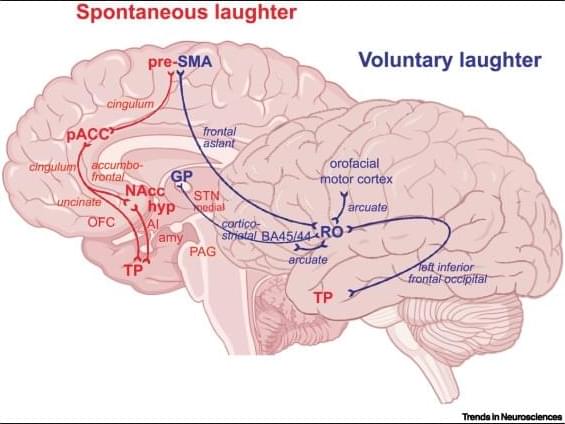
However, by looking at data from invasive brain monitoring—such as direct electrical stimulation used in medical treatments—researchers in this review paper have mapped out the brain’s “laughter engine.”
Not all laughter comes from pure humor. We often laugh politely at a boss’s joke, chuckle to smooth over a tense moment, or use a “polite giggle” to signal friendliness during everyday conversation.
Laughter is a universal social signal and a defining clinical sign of various neurological disorders. Yet, its neural orchestration remains elusive, due in part to the challenge of reproducing its spontaneous nature in the laboratory. In this review, we showcase how recent invasive investigations—from direct electrical stimulation to intracranial recordings—unveil the underlying circuitry. We propose a dual-system framework: an evolutionarily ancient cingulo-temporal network that acts as the gateway for spontaneous, involuntary outbursts; and a lateral motor-opercular system that co-opts speech-production networks for volitional, conversational laughter.