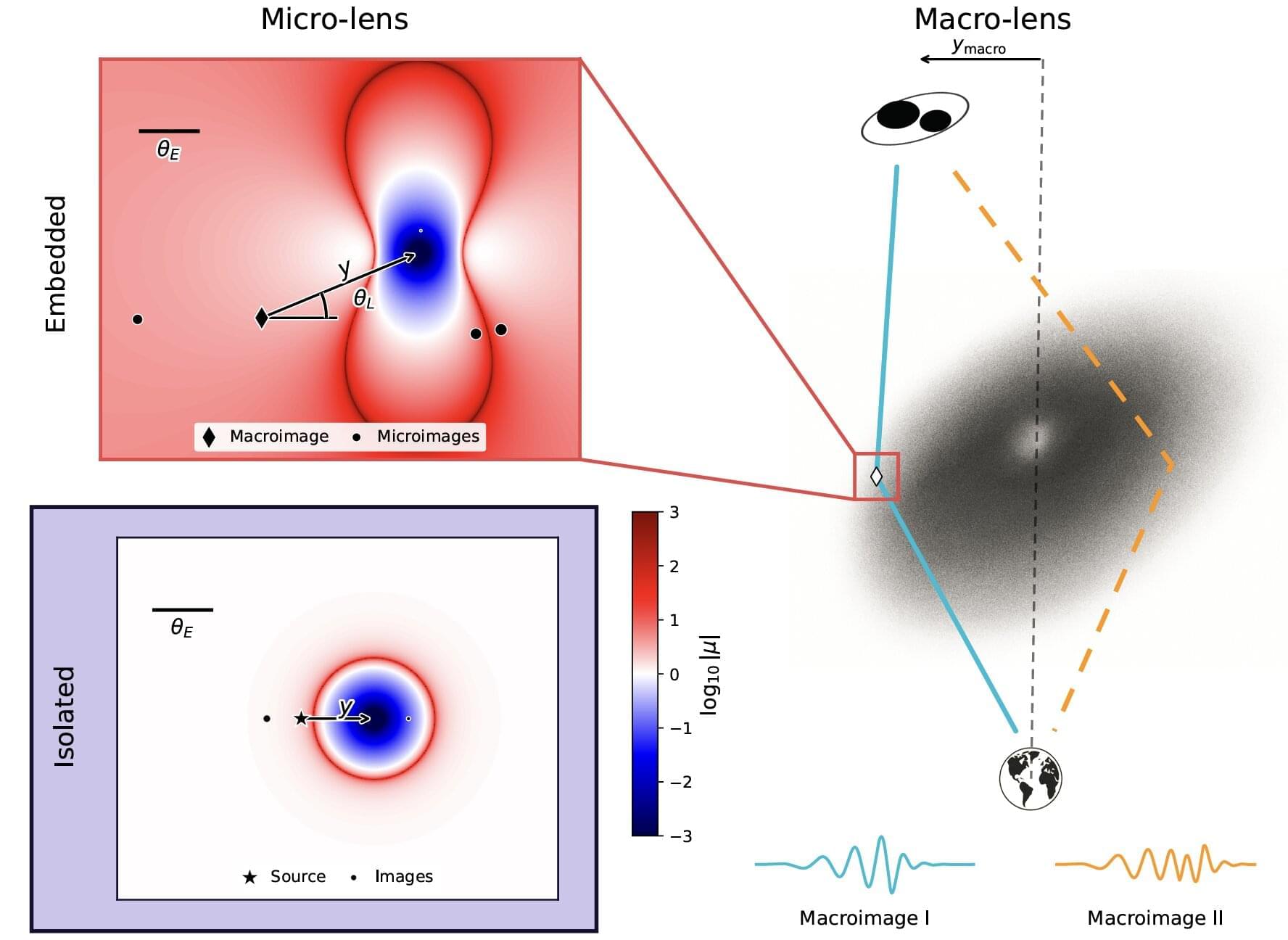
Gravitational waves are ripples in spacetime created when pairs of black holes spiral into each other and eventually merge. But if this ripple has been warped by another massive object on its way to Earth, a new analysis suggests that these black holes might appear far larger than they really are.
In the analysis published in The Astrophysical Journal Letters, Miguel Zumalacárregui and colleagues at the Max Planck Institute for Gravitational Physics revisit the signal from what appeared to be the largest black hole merger ever recorded. They conclude that the objects were likely far lighter than first thought.