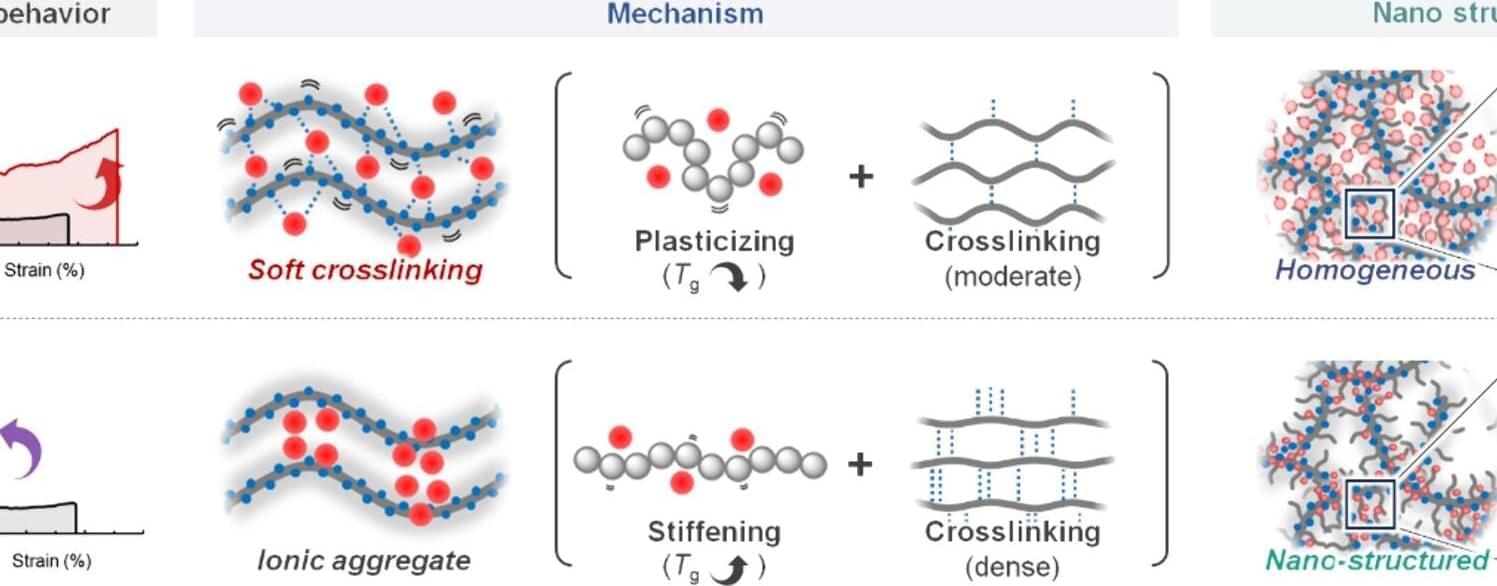
Glassy polymers are those whose chains become immobilized below their glass transition temperature. The immobilized chains make them hard and stiff but also brittle, causing them to fracture when stretched. One promising strategy for overcoming this trade-off is to incorporate ionic groups whose reversible electrostatic attractions form physical crosslinks that improve toughness while maintaining stiffness.
Although ionic liquid-based materials have demonstrated that uniformly distributed ionic interactions can improve toughness, this strategy has been difficult to apply to conventional glassy polymers. A more general molecular design strategy is therefore needed to create homogeneous ionic interactions in a wider range of glassy polymers.
Now, researchers from Tokyo University of Science (TUS), Japan, in collaboration with the Japan Science and Technology Agency (JST), Japan, have developed an ionic comb polymer that combines a comb-shaped architecture with bulky 4-dimethylaminopyridine (DMAP) counterions to maintain a homogeneous nanostructure with uniformly distributed ionic interactions, enabling glassy polymers to become both stiff and tough.