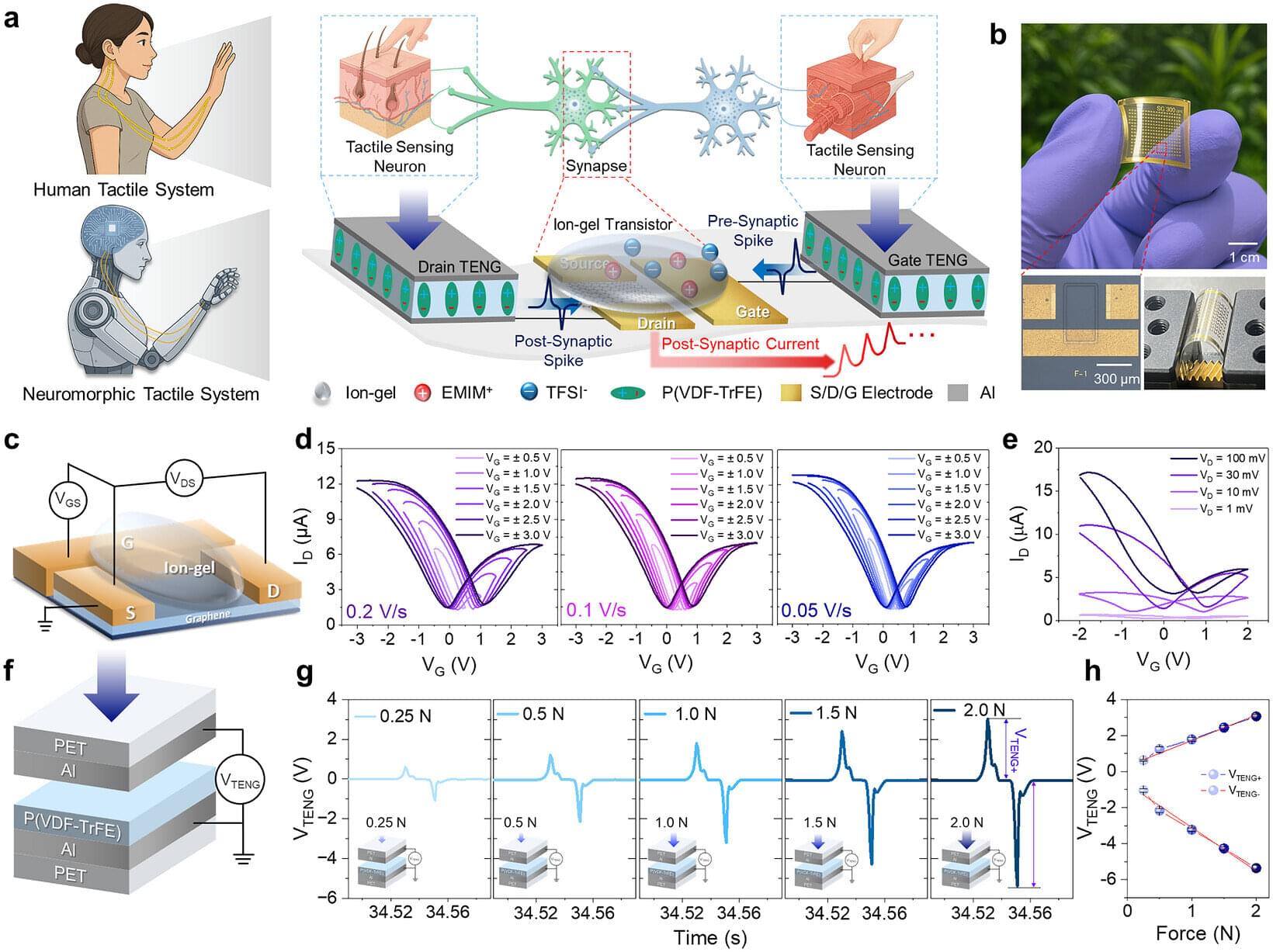
Neuromorphic devices, which are designed to emulate aspects of biological neural networks, are promising candidates for low-power, intelligent sensing technologies, including wearable applications.
Among the architectures explored for neuromorphic computing, graphene-channel ion-gel-gated transistors (g-IGTs) are attractive because of their electronic properties, flexibility, low-voltage operation and ability to modulate synaptic weights to mimic biological synapses. However, most current g-IGTs still rely on external power supplies, limiting their practical use in wearable neuromorphic systems.
To address this challenge, a research team led by professor Sejoon Lee of the Department of System Semiconductor at Dongguk University in South Korea has developed a battery-free, self-powered, flexible g-IGT device driven by a triboelectric nanogenerator (TENG). TENGs convert mechanical stimuli, such as body movement, touch or vibration, into electrical signals.