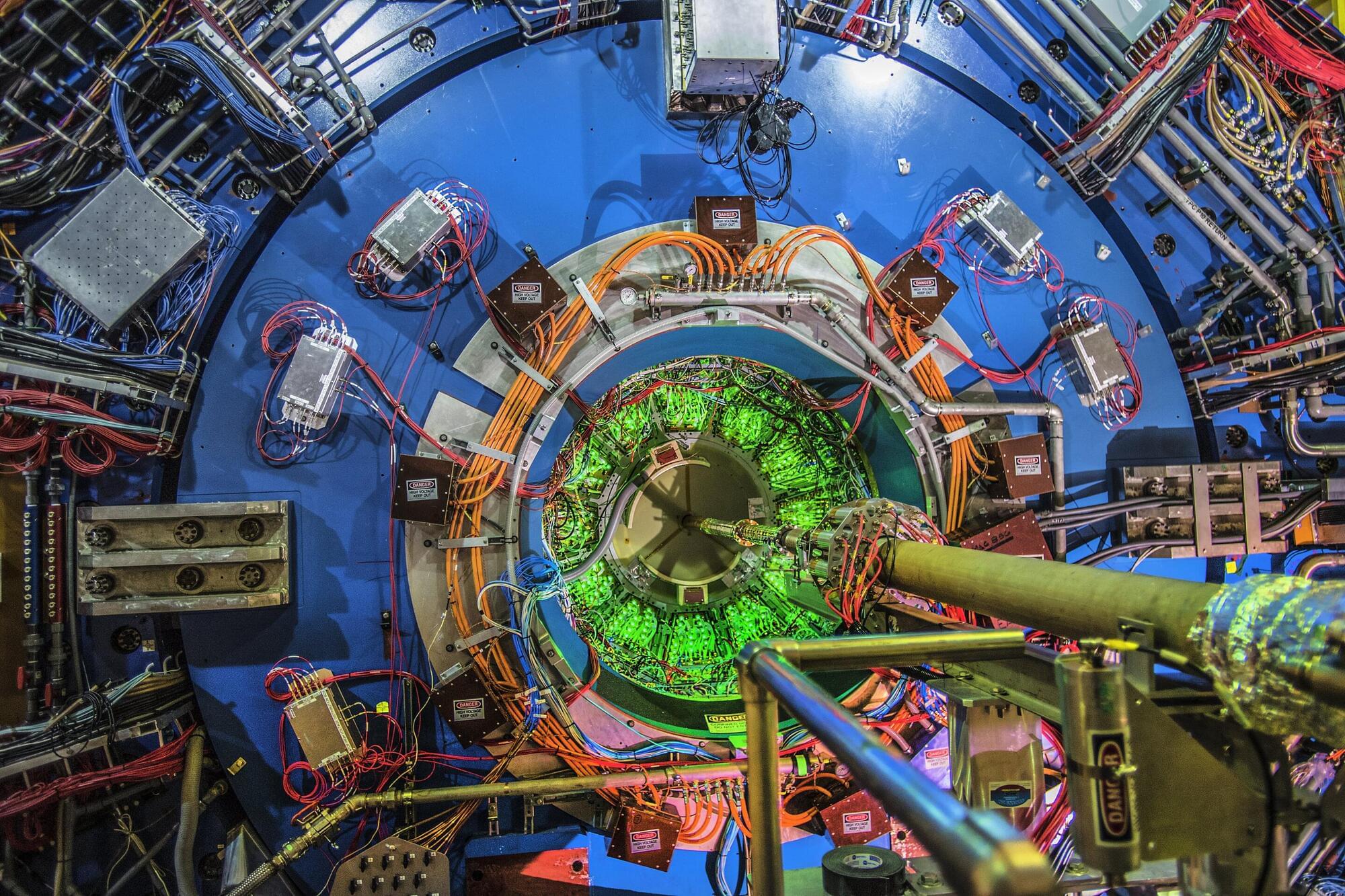
Scientists using the STAR detector to study particle collisions at the Relativistic Heavy Ion Collider (RHIC) have found an intriguing dip in their data in a relatively unexplored region of the nuclear phase diagram—a map of how nuclear matter behaves under various conditions of temperature and density. The dip appears in data tracking collision-by-collision variations in the momenta of particles emerging from collisions between gold nuclei at RHIC, near RHIC’s lowest collision energies. These collisions create the highest-density nuclear matter and may indicate that something interesting is happening in that dense region of the phase diagram. The findings are described in a paper just published in Physical Review Letters.
RHIC, which operated as a U.S. Department of Energy (DOE) Office of Science user facility for nuclear physics research at DOE’s Brookhaven National Laboratory from 2000 to 2026, was designed to create exotic forms of matter, including the quark-gluon plasma that existed in the very early universe and matter that approaches the density of neutron stars. A dip in the momentum fluctuations—which are closely tied to the temperature of the matter—may be a sign that the way nuclei transform into these exotic substances changes character at RHIC’s lower energies.
Exploring whether such a change in transition behavior exists—and, if so, where a hypothesized “critical point” demarcating this change is located on the nuclear phase diagram—has been a long-sought goal of physicists conducting research at RHIC.