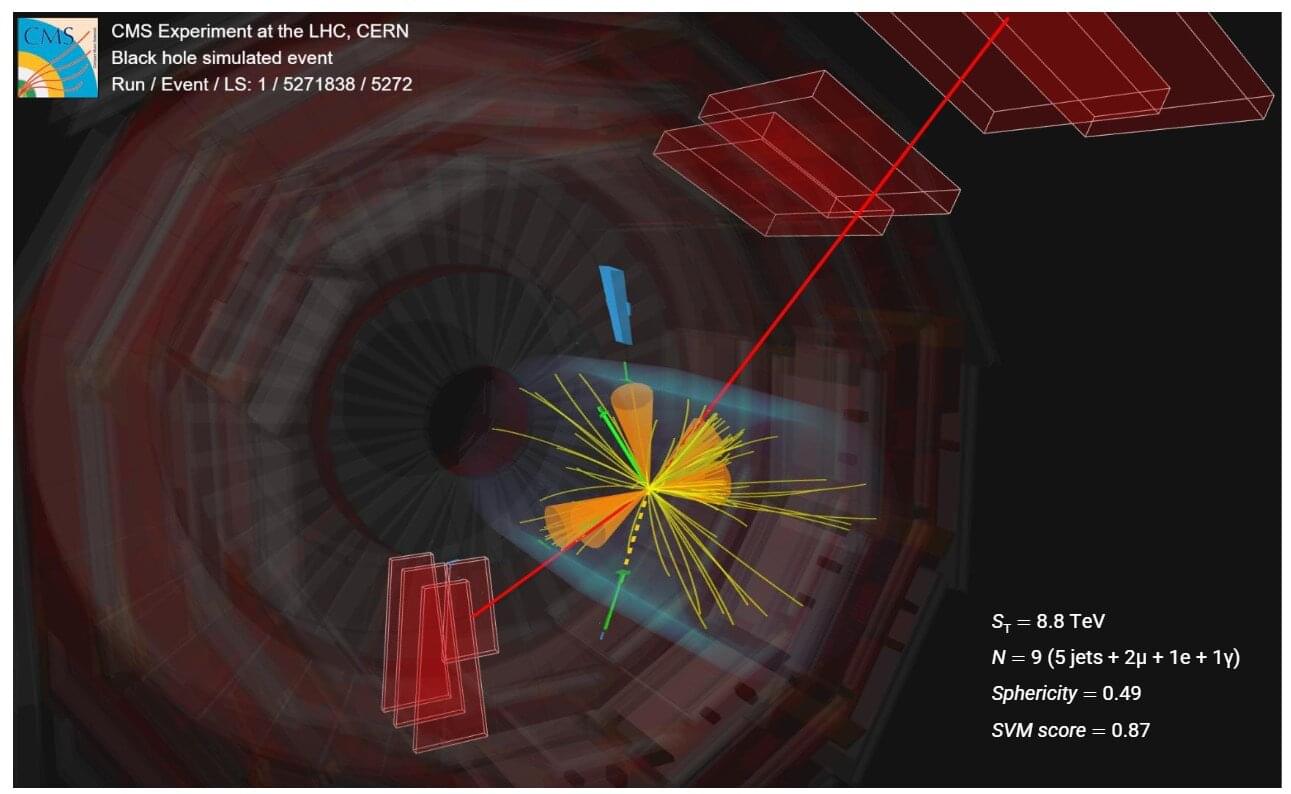
Physicists at UC Santa Barbara have extended the search for evidence of microscopic black holes produced at the Large Hadron Collider (LHC) at the European Organization for Nuclear Research (CERN). The formation of these tiny, fleeting objects at the LHC represents one way theorists have sought to resolve anomalies in our understanding of the basic structure of spacetime, while the method used to look for them demonstrates a new way of searching for new particles.
“Had we found evidence, we could have begun to directly study quantum gravity,” said Tamas Vami, a researcher in the Compact Muon Solenoid (CMS) experiment who is conducting his postdoctoral work under the guidance of UCSB physics professor Joe Incandela. “It’s a step toward unifying all of the known fundamental forces, which has been a goal of physicists for more than a century.”
But a null result does not make for a fruitless search, said Incandela Lab graduate student researcher Danyi Zhang. Quite the opposite.