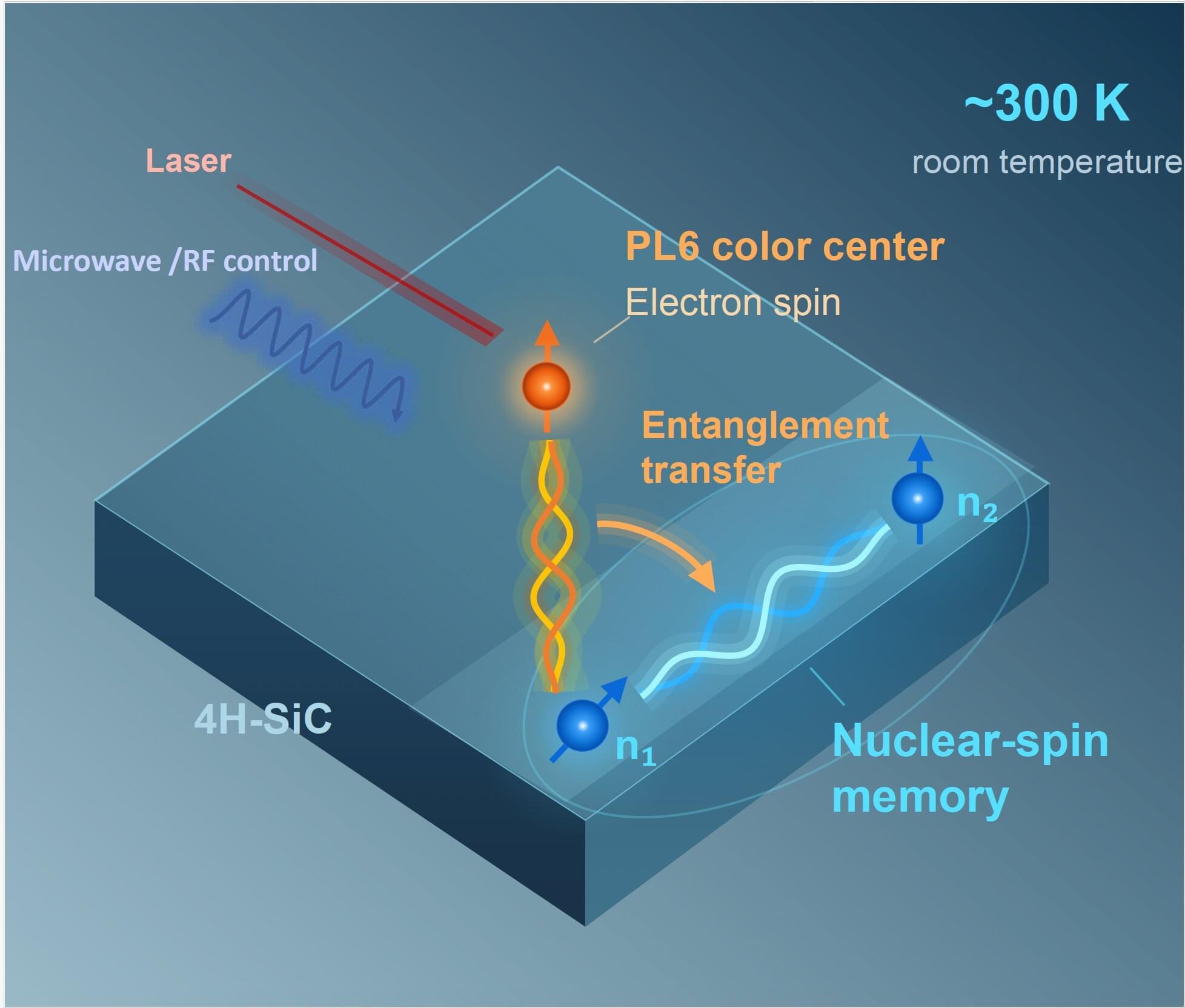
Researchers in China have extended the lifetime of entanglement in a room-temperature, solid-state system by up to a factor of 240. Led by Shuo Ren and Rui-Jian Liang at the University of Science and Technology of China in Hefei, the team transferred entangled states from the electron spins of solid-state defects to the spins of surrounding atomic nuclei, which are far more resilient to noise. The research has been published in Physical Review Letters.
When two or more quantum particles are entangled, their properties remain correlated no matter how far apart they are: Measuring one immediately tells you something about its entangled partners. This phenomenon is increasingly being explored for quantum sensing and information processing, where entangled networks of quantum bits, or “qubits,” can perform tasks beyond the limits of classical systems.
The enduring challenge is that quantum information is quickly destroyed as qubits interact with thermal fluctuations in their surroundings. This noise can be minimized by cooling systems to ultracold temperatures—but today, physicists are also exploring more practical approaches, in which qubits have built-in resilience against their environment while still allowing information to be easily written and read out.