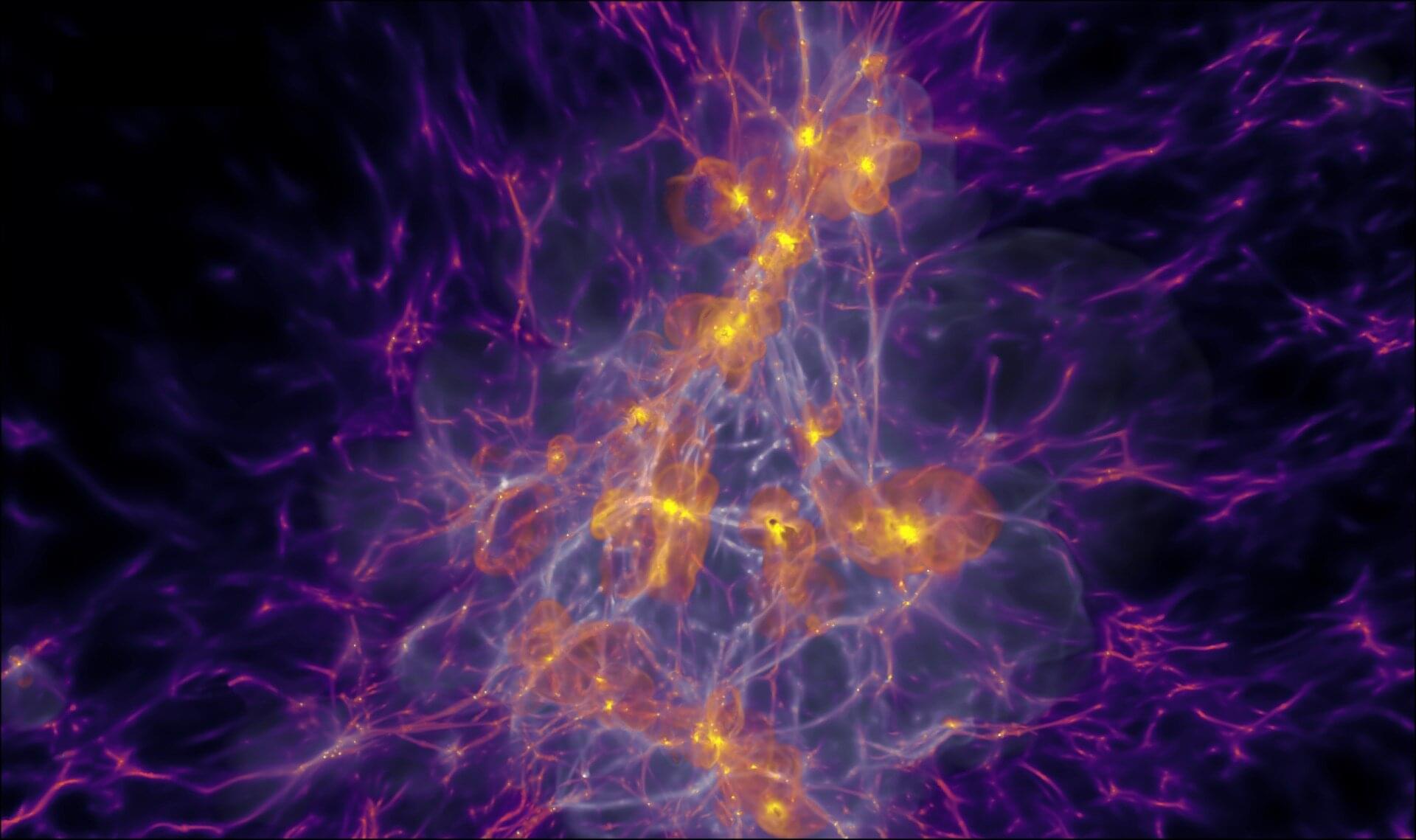
Researchers have used some of the most detailed simulations yet of the early universe to investigate how the first stars and galaxies formed. Led by researchers at the University of Bath in the U.K., alongside collaborators at the University of Chicago in the U.S. and the Institut d’Astrophysique de Paris in France, the MEGATRON project uses advanced simulations to explore how the first stars and galaxies lit up the previously dark cosmos and enriched it with the chemical elements that would later become the building blocks of everything around us.
Published in the Open Journal of Astrophysics, four studies from the MEGATRON project combine cutting-edge cosmological simulations with sophisticated models of radiation, chemistry and galaxy formation. Together, these constitute the collaboration’s first substantial body of published results, with further papers expected to follow.
The findings from the study of the first stars show that accurately capturing the interplay between starlight, gas and newly forged elements is essential for connecting two previously separate views of the early universe: observations of young galaxies by the James Webb Space Telescope (JWST) and the chemical clues preserved in ancient stars in and around the Milky Way—the galaxy that contains our solar system.