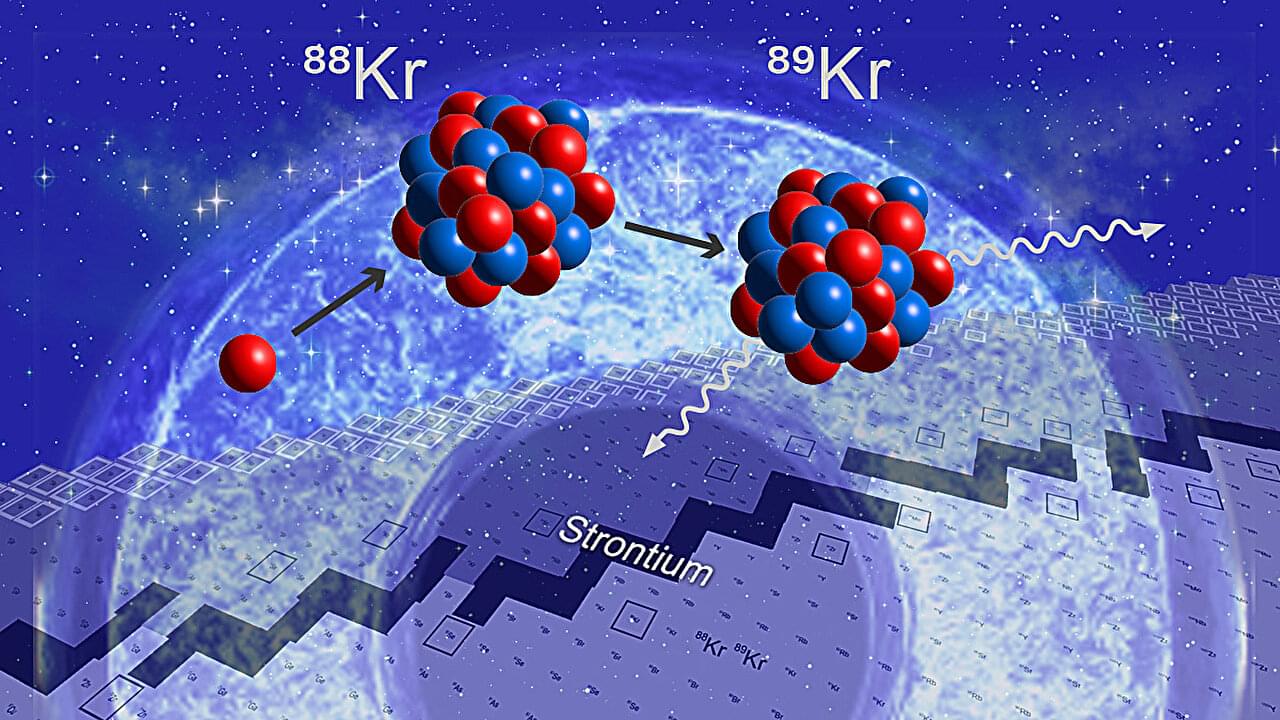
An international research team has reported the first experimental investigation of a nuclear physics reaction essential for understanding how the element strontium is produced in stars—specifically in stellar environments where traditional explanations for its formation fall short. The study, published June 8 in Communications Physics, reports that the team used indirect experimental techniques to extract previously inaccessible information about how an isotope of a separate element—krypton—absorbs, or captures, neutrons.
Their measurements reduced the uncertainty of the neutron-capture rate of this isotope, krypton-88, from at least a factor of eight to about a factor of three. The team showed that the true rate of neutron capture by krypton-88 is consistently lower than theoretical predictions. When they incorporated these observations into leading models of how stars forge heavy elements—the intermediate neutron-capture process (i-process)—they discovered that the new rate increased the predicted amount of strontium, bringing simulations into better agreement with astronomical observations.