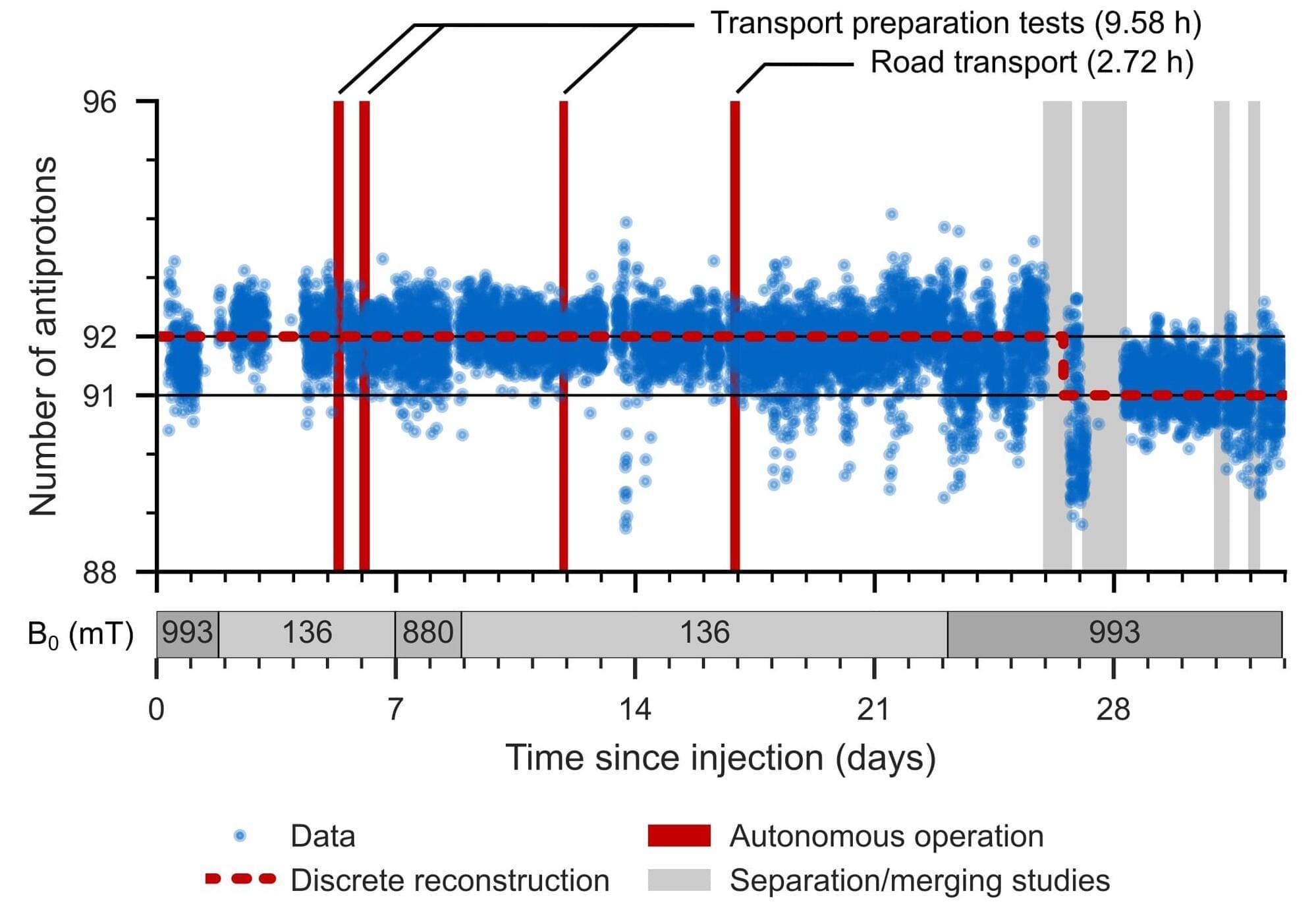
In March 2026, scientists succeeded in transporting antiprotons by road for the first time in a purpose-built trap loaded on a truck. The BASE collaboration, which realized this experiment at the European Organization for Nuclear Research (CERN) in Geneva under the lead of Professor Dr Stefan Ulmer and Dr Christian Smorra from Heinrich Heine University Düsseldorf (HHU), now presents its findings and experiences from this pioneering experiment in the journal Nature. Among other things, they report that it was possible to store antiprotons in a mobile transport vessel for more than a month for the first time ever.
Comparing protons—the positively charged components of an atomic nucleus—with antiprotons—their antimatter counterparts—is one of the most promising methods for seeking differences between matter and antimatter. Any identified difference in their mass or magnetic moment could point to the potential origin of the matter-antimatter asymmetry that can be observed in the cosmos.
So-called ultra-high-vacuum Penning traps enable high-precision measurements of the protons and antiprotons confined in them. The BASE (Baryon Antibaryon Symmetry Experiment) research collaboration designed and now operates a trap of this kind—known as BASE-STEP—at CERN, or more precisely, the “Antimatter Factory” (AMF) there. The AMF is the only facility worldwide where low-energy antiprotons can be produced, stored and studied.