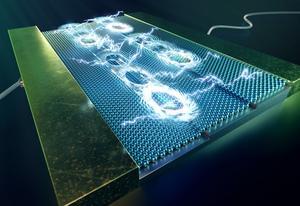
Researchers at the Research Center for Materials Nanoarchitectonics (MANA), one of the centers under the National Institute for Materials Science (NIMS), Japan, discovered that atomic-scale steps can guide superconducting vortices in an ultrathin superconductor. Vortices moved more than 1,000 times more easily along the steps than across them, and this guiding effect could be tuned by temperature and magnetic field.
Superconducting vortices are tiny quantum objects whose movement can strongly influence how superconductors behave. Controlling their direction of motion could therefore be important for developing ultralow-power superconducting technologies. However, directional control of vortices in two-dimensional superconductors has remained challenging. Achieving such control could help develop future superconducting devices that consume less power while improving processing efficiency.
Addressing this challenge, a research team led by Takashi Uchihashi from Research Center for Materials Nanoarchitectonics (MANA), National Institute for Materials Science, Japan, investigated an ultrathin superconductor with regularly arranged atomic steps on its surface. Scanning tunneling microscopy confirmed the parallel steps and directly visualized vortices located along them. Their findings were published in the journal Physical Review B on July 30, 2026.