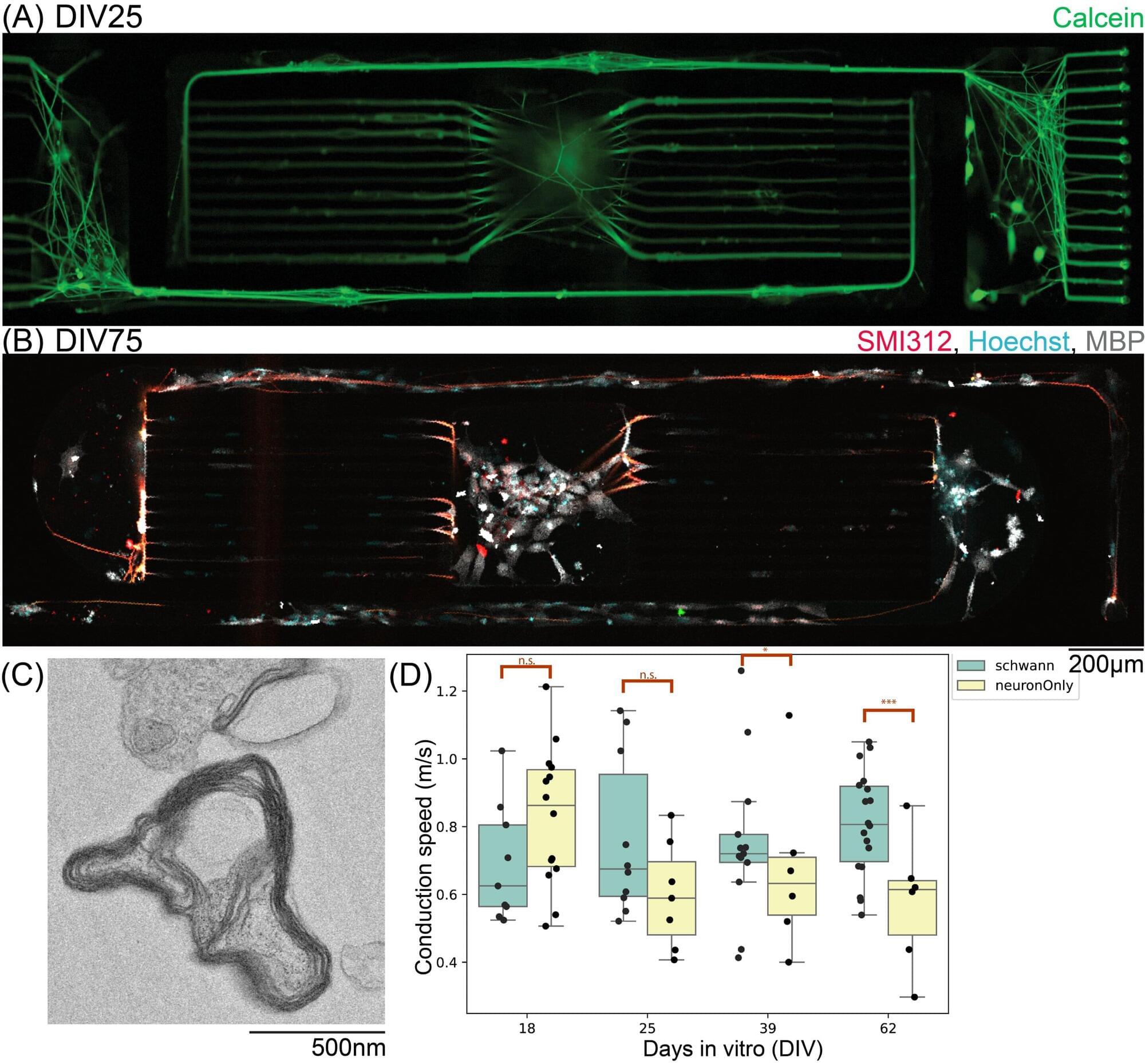
Rice University and collaborators in Switzerland have developed a platform to grow human-derived nerve cells and Schwann cells, supporting cells that form a protective coating called myelin around nerve fibers. This platform enables the formation of functional myelin in a three-dimensional, lab-grown environment. Researchers confirmed that it worked by measuring an increase in the speed of electrical signals traveling across networks of connected nerve cells.
Developed at Rice and ETH Zurich, the platform combines human-derived cells, tissue-like materials and electrical measurements in one system. Because nerves contain many cell types and can be difficult to access without damage, researchers can use the model to study how myelin develops, how injury or exposure to toxins affects it and whether drugs or electrical stimulation can prevent its loss or promote repair. The platform can also be adapted to model the brain and measure complex cellular processes. The study was published Aug. 26 in Advanced Healthcare Materials.
“While the formation of myelin is exciting to see, we are even more excited that it is functional and changes how the nerve communicates,” said Christina Tringides, corresponding author and assistant professor of materials science and nanoengineering at Rice.