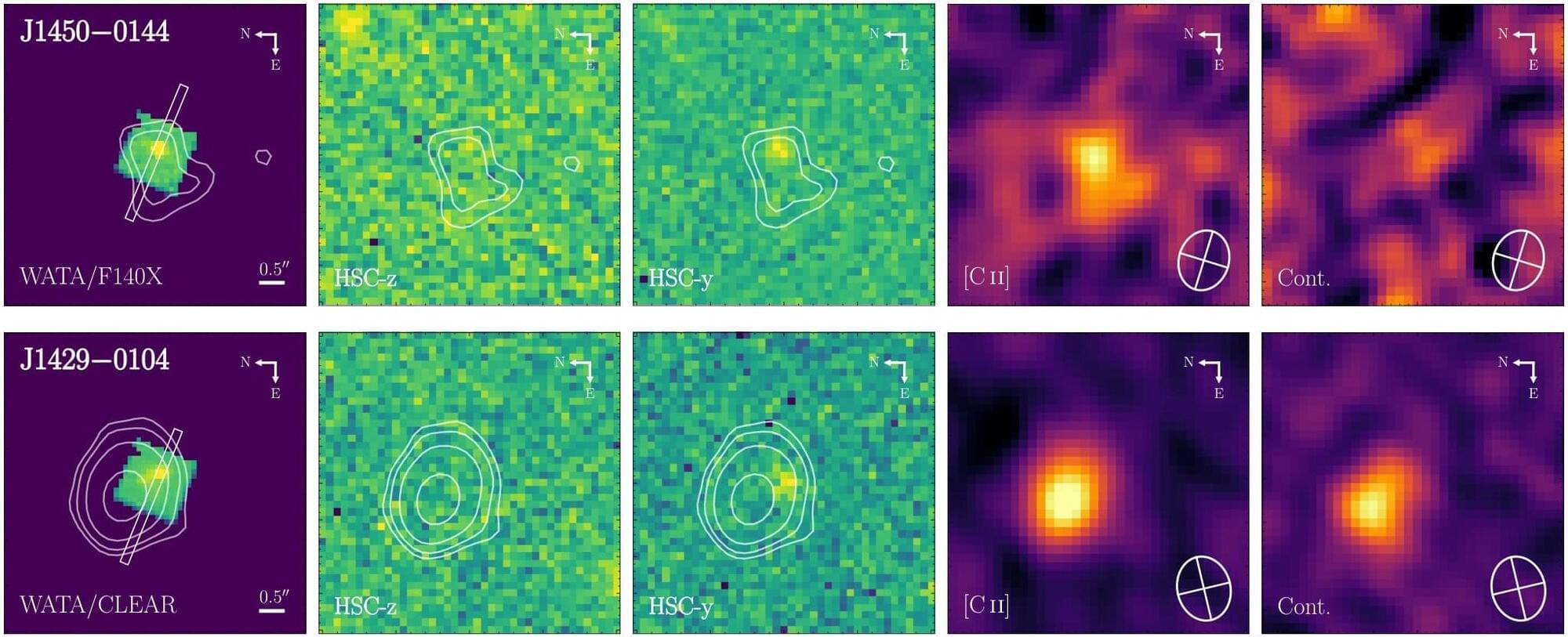
A new study finds that two early-universe objects thought to be faint quasars are actually extraordinarily luminous galaxies powered by bursts of star formation. James Webb Space Telescope observations of the galaxies, seen when the universe was less than a billion years old, reveal signatures of extremely massive stars, including some potentially more than 200 times the mass of the sun. The paper outlining this discovery was posted to the arXiv preprint server on Aug. 18.
There’s a luminosity range where ultraviolet-bright galaxies and faint quasars become impossible to tell apart using standard discovery techniques. Both can show blue ultraviolet continua and prominent hydrogen Lyman-alpha emission lines, and low-sensitivity discovery spectra alone cannot distinguish which is which.
This ambiguity affects how astronomers count quasars and extremely bright, actively star-forming galaxies in the early universe. During their quasar searches, astronomers have detected a significant number of UV-bright galaxy candidates in the Subaru High-z Exploration of Low-Luminosity Quasars survey (SHELLQs).