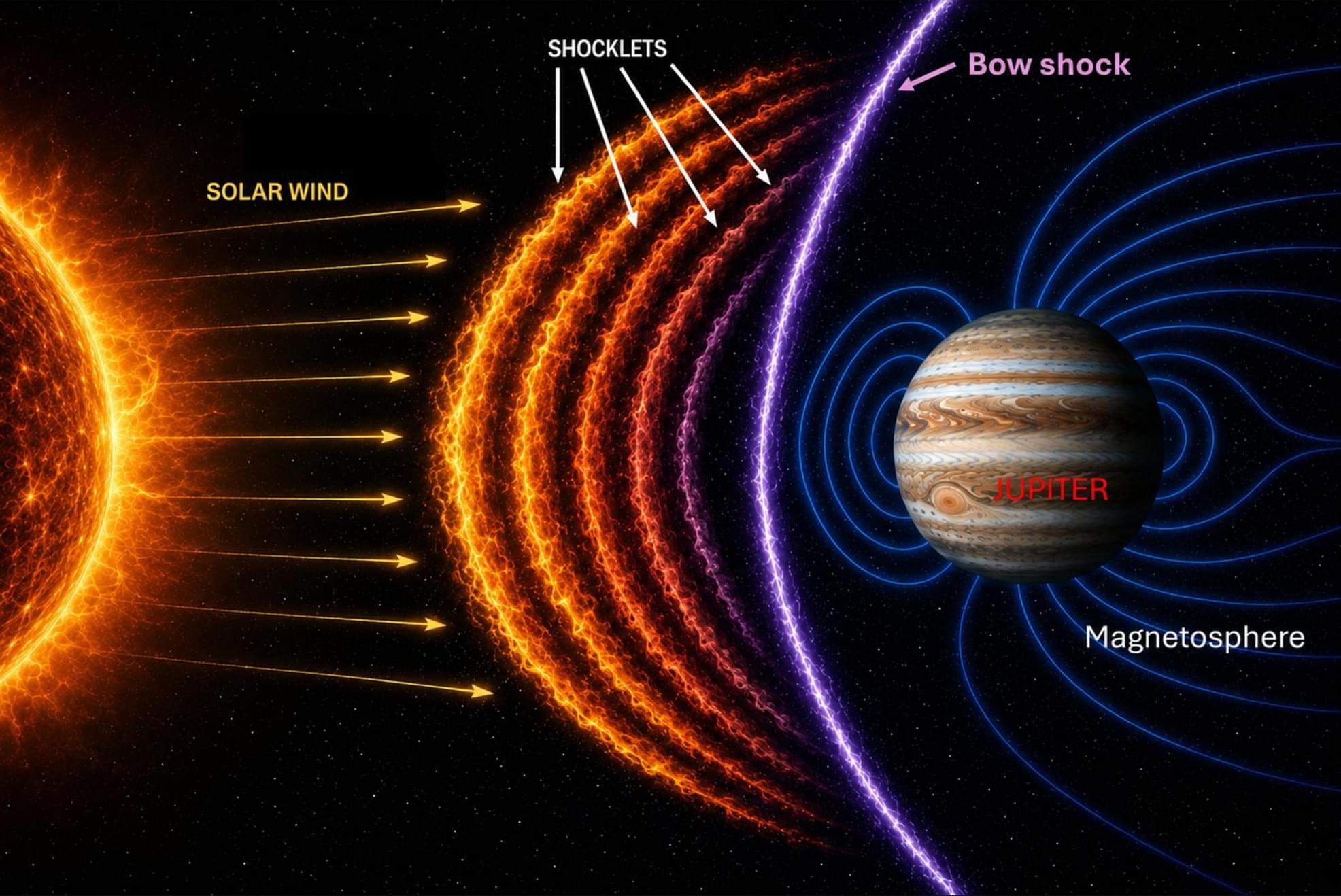
New observations from NASA’s Juno mission are revealing that Jupiter’s bow shock behaves in more complex ways than its counterpart at Earth.
NASA’s Juno spacecraft has captured the most detailed measurements yet of Jupiter’s bow shock, the vast boundary where the solar wind crashes into the planet’s magnetic environment. The observations show that Jupiter manages this high-energy interaction very differently from Earth, using a more complex mix of plasma waves and smaller shock structures to slow incoming particles.
The results, reported by a University of Iowa-led team, also give researchers a nearby example of shock physics that could help them study far more energetic environments, including the remnants of exploded stars.