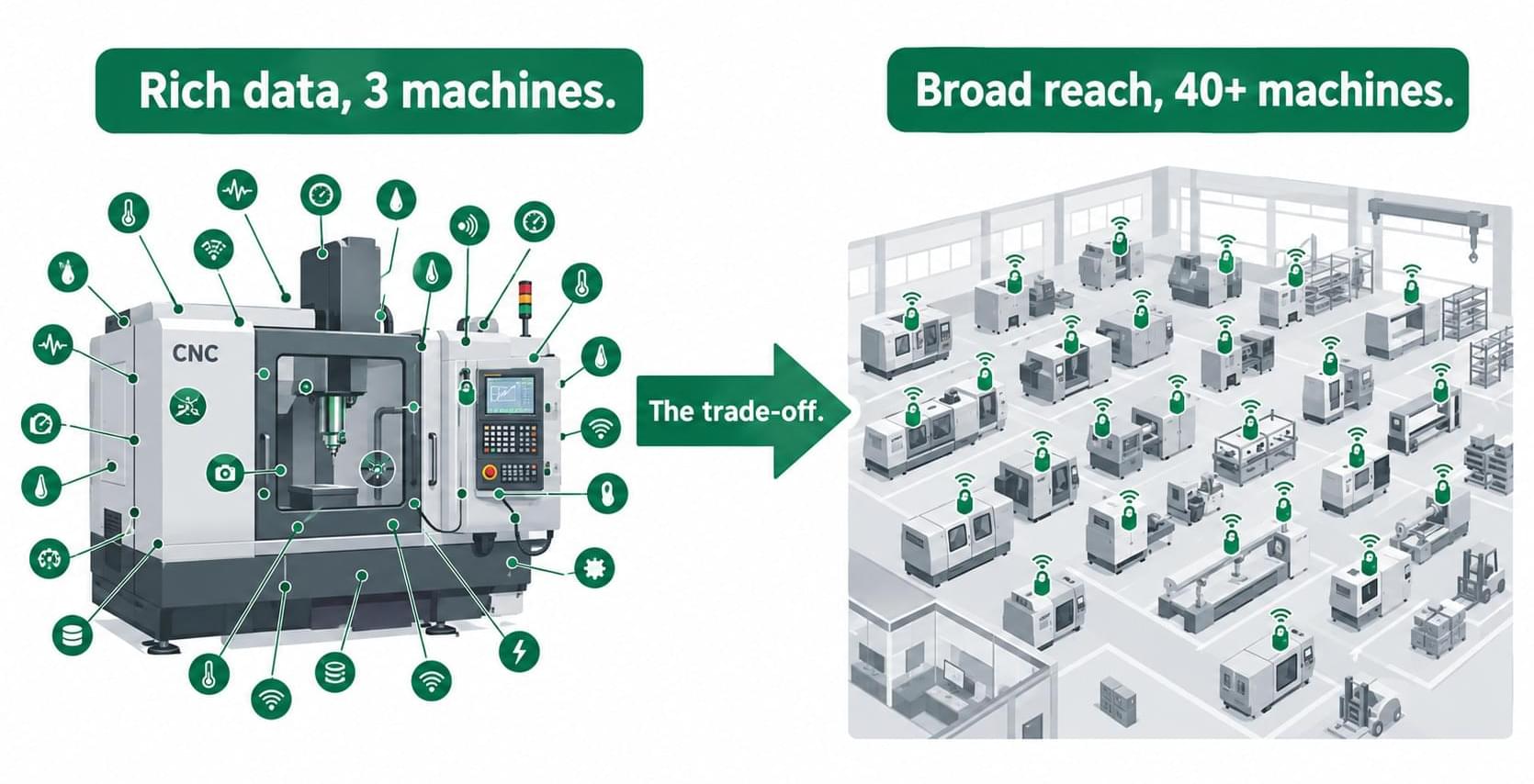
Industrial IoT Coverage Beats Sensor Richness — FourJaw Proves It.
FourJaw started with the classic approach: pull rich data straight from CNC controllers. It worked on the first few machines. Then every new site became its own integration project.
Customers mainly wanted one answer: is this machine making us money?
So FourJaw switched to a simple external power sensor that clips onto any machine’s cable. Lower resolution, but it works on decades-old equipment and unfamiliar brands. They pair it with an operator tablet for reason codes.
The next bottleneck was the network. Customer Wi-Fi and security policies killed more rollouts than the sensor itself. The fix was shipping cellular routers that never touch the corporate network.
The lesson for buyers: score vendors on how many machines they can reach without controller access, what a new site costs without a vendor visit, and whether connectivity can route around a Wi-Fi refusal.
Coverage decides whether monitoring survives past the pilot. Resolution does not.
Full analysis:
#IndustrialIoT #IIoT #SmartFactory #MachineMonitoring
Industrial IoT coverage — how many machines a program can actually reach — decides whether monitoring survives past a demo, not the resolution of any single sensor. UK manufacturing-analytics vendor FourJaw abandoned rich CNC-controller data for an external power sensor that fits any machine, then found the real ceiling was the network, not the hardware.
The lesson for buyers is to price friction before resolution: ask what a rollout costs per site, not what a single pilot machine can report, and treat network access as a procurement line item rather than an engineering afterthought.
Industrial IoT coverage is the metric the industry keeps underpricing. A September 23 IoT Business News account by Soracom’s Ryan Carlson traces how FourJaw Manufacturing Analytics, a 2020 Sheffield AMRC spinout, rebuilt its product around reach instead of data depth. The company’s founders came out of a research culture that once mounted roughly 1,000 sensors on a single CNC machine in a project literally named “The Full Monty.” Their first product followed that instinct: pull rich data straight from CNC controllers, detailed enough to reverse-engineer a part from its coordinates.