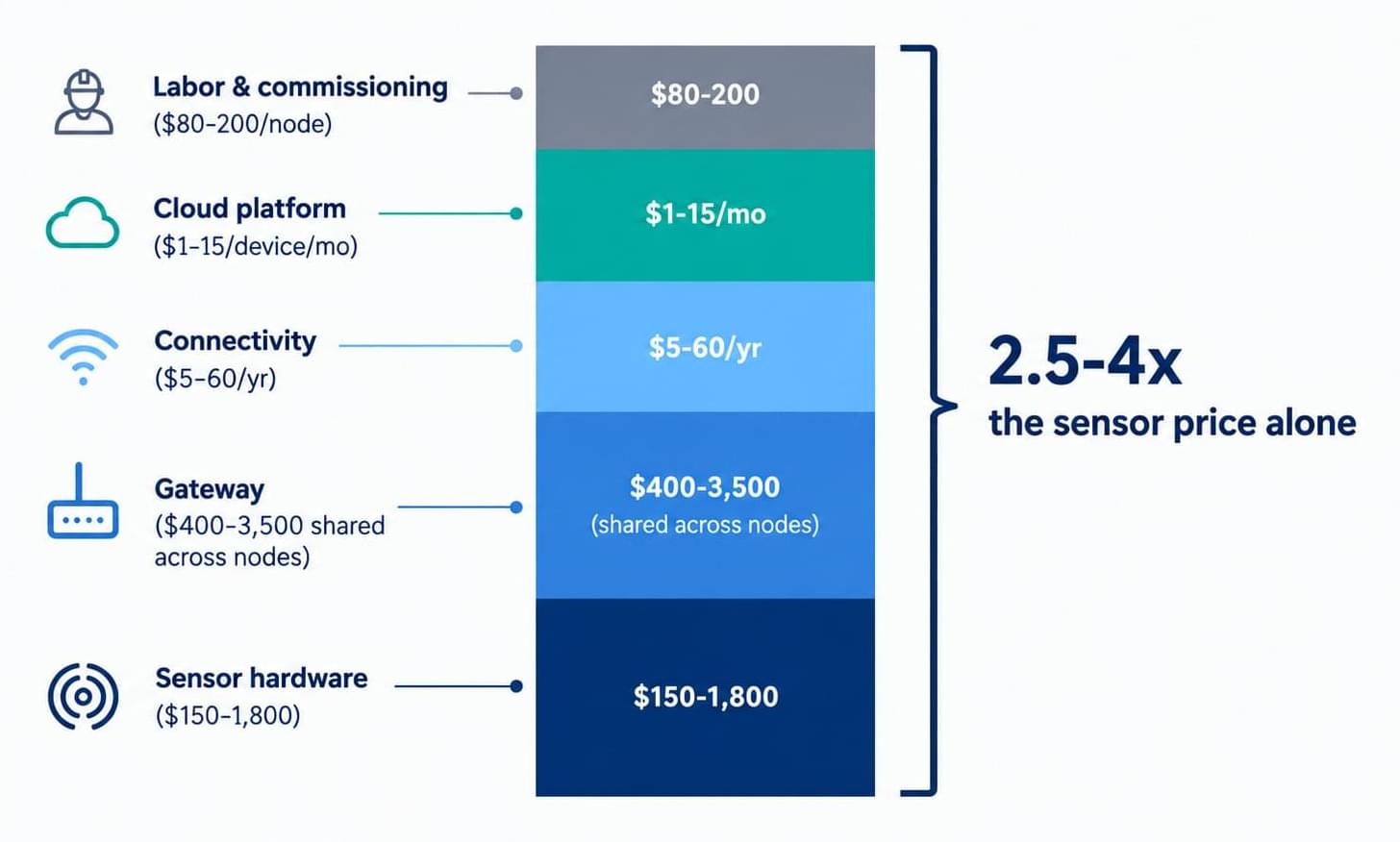
Every industrial IoT sensor cost estimate that stops at the per-unit hardware price is wrong by design, not by accident — vendors quote the number that looks smallest. A defensible 2026 budget has to account for four separate cost layers that stack on top of each other: the sensor itself, the gateway and connectivity that gets its data out, the cloud platform that stores and processes it, and the labor to commission and maintain the whole system.
Basic industrial sensors — simple temperature or contact points — run $150–$350 per unit. Mid-range vibration sensors with FFT analysis cost $400–$800, and industrial-rated units certified for hazardous locations (ATEX/Class 1 Div 2) run $900–$1,800. Wireless temperature transmitters land at $120–$450 per point, and combining vibration and temperature into a single node typically cuts per-point cost by 15–25% versus separate devices on the same asset. This layer is what most vendor pricing pages show — and it’s typically only 30–50% of total industrial IoT sensor cost once the rest of the system is added.
Industrial gateways from vendors like Phoenix Contact, Advantech, or Siemens run $400–$3,500, with LoRaWAN, WirelessHART, or Bluetooth mesh gateways covering 50–500 sensor nodes per unit. Connectivity is where the real variation shows up: LoRaWAN costs $5–$15 per sensor per year, cellular LTE-M or NB-IoT runs $20–$60 per year (plus $30–$80 per month for a cellular gateway’s data plan), Wi-Fi is effectively free if the infrastructure already exists, and satellite connectivity starts around $200 per year for remote sites with no other option. A LoRaWAN module itself costs $8–$10, versus $3,200–$10,700 in full equipment cost for a comparable cellular site.