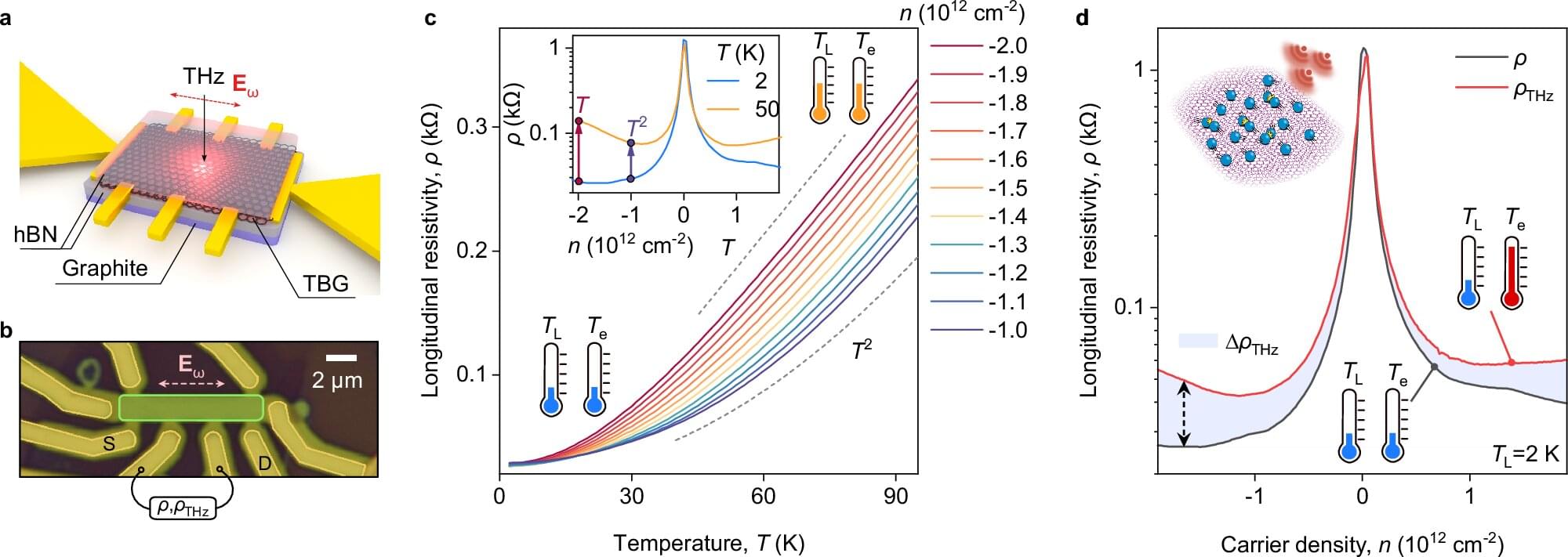
When a material heats up, its electrical resistance often rises. The harder question is what, exactly, is getting in the way. The electrons carrying the current may be scattered by vibrations of the material’s atomic lattice, known as phonons. They may also collide with one another. Frustratingly, a conventional temperature test warms the electrons and the lattice together, so the effects arrive tangled in the same resistance measurement.
Researchers from the Institute for Functional Intelligent Materials (I-FIM) at the National University of Singapore (NUS) have now pulled those effects apart in twisted bilayer graphene, a material made by stacking two sheets of graphene at a slight angle. In a paper published in Nature Communications on Aug. 13, 2026, the researchers used terahertz radiation to warm the electrons while keeping the surrounding lattice almost unchanged. The material’s resistance climbed by several kilohms in devices twisted close to the so-called magic angle, revealing a strong electronic contribution even in regimes often associated with phonons.
“Conventional transport measurements heat the electrons and the lattice together, so their fingerprints are superimposed,” said assistant professor Denis Bandurin, a principal investigator at I-FIM, who led the study. “We wanted to separate those two temperatures and ask what the electrons themselves were doing.”