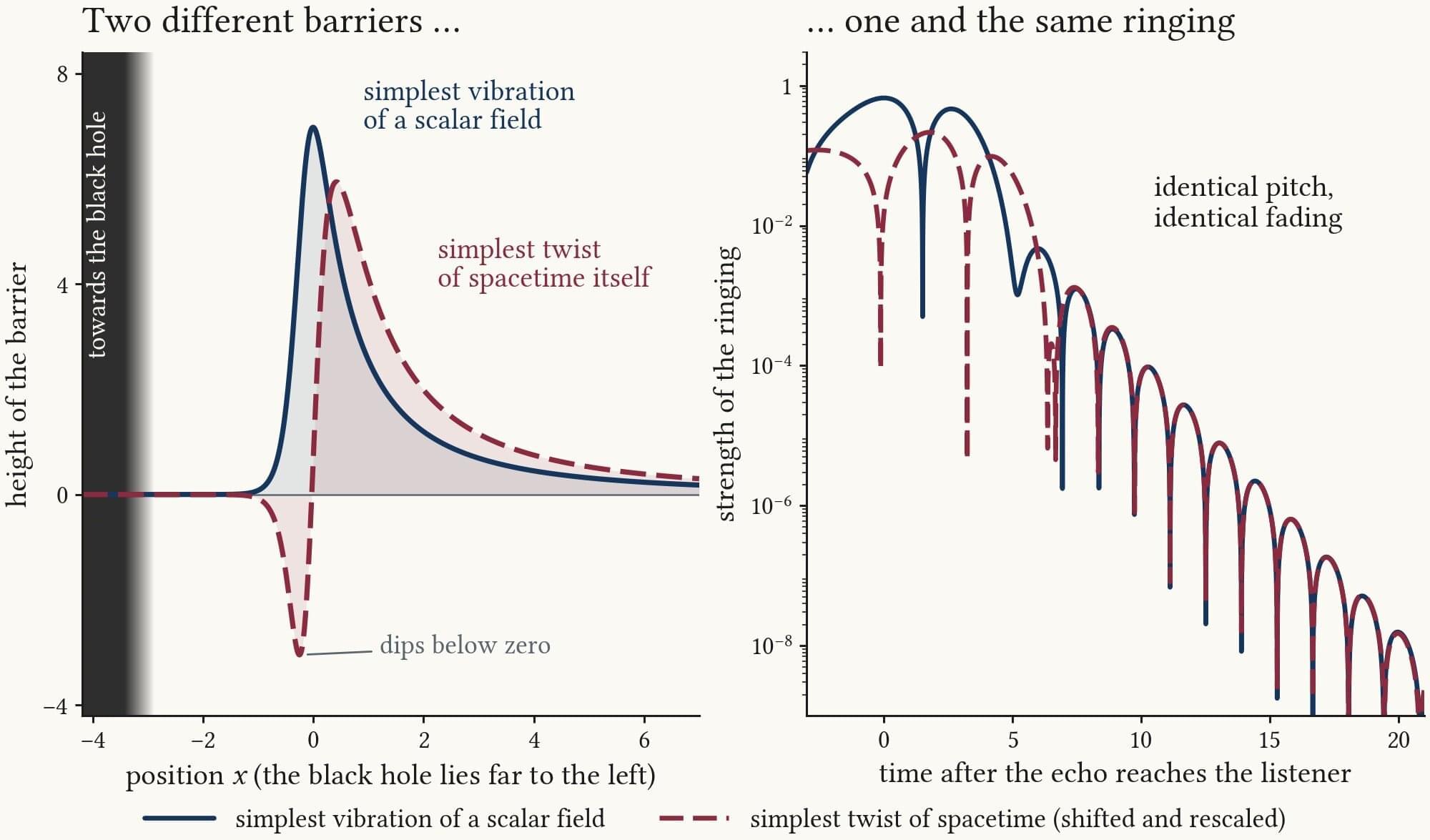
Strike a bell, and it rings with a pitch and a fading that tell you about the bell: its size, its shape, the metal it is made of. Black holes ring too. When two merge, the newborn black hole shivers and sheds gravitational waves in a brief, dying chord, and since 2015, gravitational-wave detectors have been listening. The notes of that chord, which physicists call quasinormal modes, depend only on the black hole’s mass and spin and on the law of gravity itself. Change the law, and the chord changes.
My colleague Davide Batić and I, both mathematicians at Khalifa University in Abu Dhabi, wanted to know how the chord changes when space has more dimensions than the three we see, and when Einstein’s equations receive a correction suggested by string theory. We report the answer in a paper published in Physical Review D. Along the way, we met something we had not been looking for: two quite different kinds of waves that ring at exactly the same notes.
Several attempts to unite gravity with quantum physics, string theory first among them, need extra dimensions of space. At low energies, some string theories add a term to Einstein’s equations built from the curvature of spacetime, called the Gauss–Bonnet term. In our four-dimensional spacetime, this term leaves the gravity equations unchanged; it only comes alive when there are more dimensions.