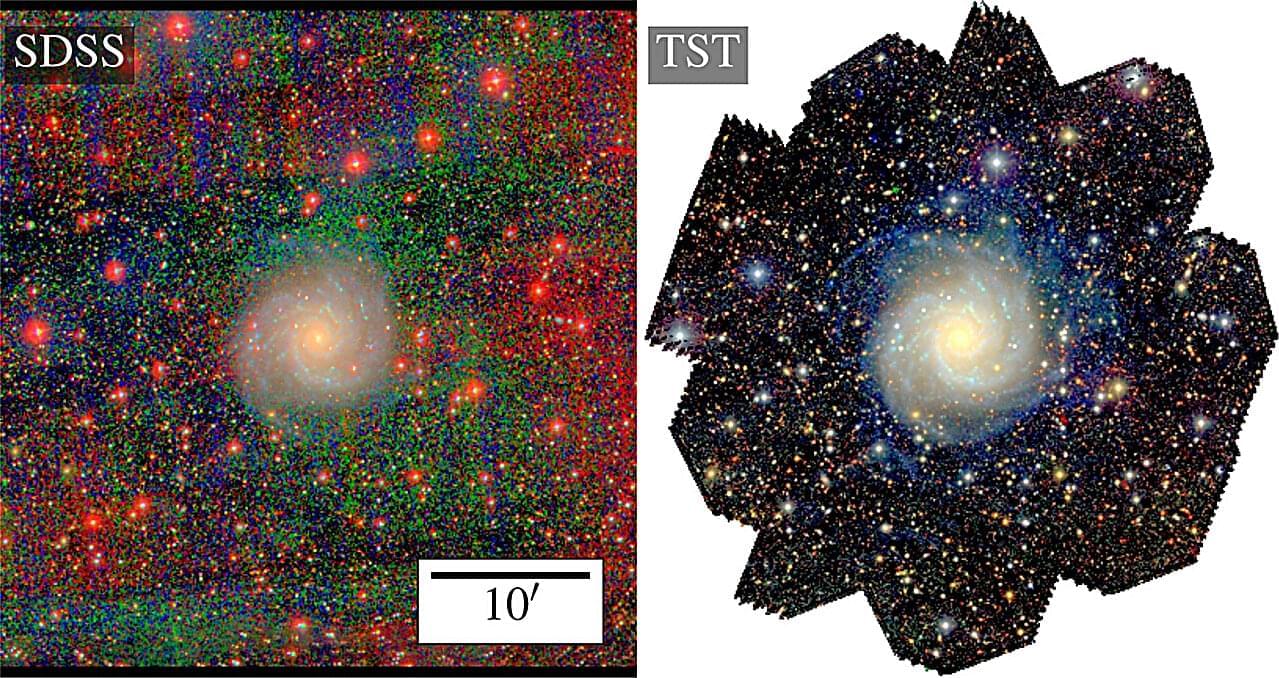
Astronomers have discovered a faint population of young stars extending far beyond the known edge of the nearby spiral galaxy Messier 74. The finding suggests the galaxy is nearly twice as large as previously measured. The new study was published Sept. 4 in Astronomy & Astrophysics.
Over time, galaxies grow by accumulating gas from their surroundings. Because this newer gas spins faster relative to the center, it cannot collapse all the way to the core. Instead, it settles into the outer disk, where it eventually sparks the formation of new stars. Astronomers have observed this growth, but whether it is smooth and gradual or occurs in fast, episodic bursts remains unclear. Mergers or interactions with satellite galaxies can also trigger bursts of star formation in the outskirts of galactic disks, making them grow bigger.
One way to identify such growth is the “extended ultraviolet disk” (XUV disk): UV light tracing young stars beyond a galaxy’s traditional boundary as seen in optical light. But astronomers are still debating how to define this “optical boundary,” making XUV disks difficult to classify.