Scientists found a human genetic element in a poxvirus and discovered it was both an important gene for brain function and a jumping gene capable of moving and inserting itself in genomes.
A study published Sept. 24 in Science reports that the gene, called BC200, combines a mix of characteristics that have never been seen before.
For millions of years, some stretches of DNA known as transposable elements—often described as “jumping genes”—have been able to copy themselves and insert into new locations in a genome. Although nearly half of the human genome bears traces of these elements, most are no longer capable of moving.
A new study highlights an unusual exception: BC200, a small noncoding RNA gene that was incorporated into the genomes of anthropoid primates roughly 40 million years ago and later acquired a role in regulating protein production in neurons. Scientists had assumed that, after being “domesticated” by the genome, BC200 had essentially settled into its new biological role.
Instead, the researchers found evidence that BC200 never completely lost its ability to move.
By analyzing primate genomes, they found that BC200 had repeatedly generated new copies over evolutionary time, producing hundreds of lineage-specific insertions. They also identified BC200 insertion variants that exist in some humans but not others—including very recent, individual-specific insertions—suggesting that the element may still be capable of moving today.
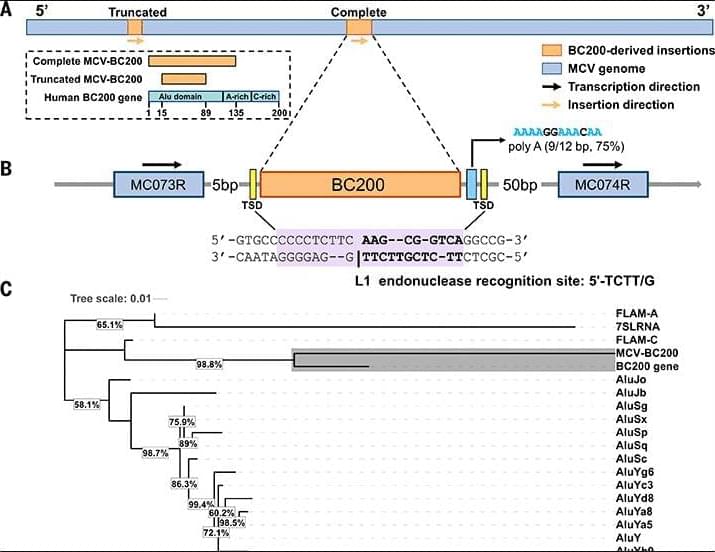
The most striking discovery came from molluscum contagiosum virus (MCV), a human-specific poxvirus. The researchers found two copies of the human BC200 sequence inside the viral genome. Their analysis suggests that these copies were acquired through the activity of LINE-1, another mobile genetic element, probably during relatively recent human evolution, potentially within the last 160,000 years.
This creates an unusual evolutionary story: a sequence that began as a mobile genetic element was co-opted into performing a useful cellular function, yet retained its ability to move—and eventually a copy appears to have escaped from the human genome into a virus.
The finding blurs the conventional distinction between a gene with a stable biological function and a transposable element capable of genomic mobility. BC200 appears to be both: a functional part of the primate genome and, remarkably, a genetic sequence that has continued to propagate itself across evolutionary time.
In simple terms: evolution did not necessarily force BC200 to choose between being a useful gene and being a “jumping gene.” It appears to have remained both.
//www.science.org/doi/10.1126/science.aeh3441
#genetics #evolution #JumpingGenes #transposableelements #HumanGenome #evolutionarybiology
Transposable elements mobilize within and occasionally between genomes, including from host to virus. We identified two insertions of the human BC200 noncoding RNA gene in the poxvirus molluscum contagiosum virus (MCV), which were likely acquired through long interspersed nuclear element 1 (LINE-1 or L1)–mediated retrotransposition during modern human history. Although BC200 was co-opted approximately 40 million years ago to regulate neuronal translation, we show that it never lost its mobilization capacity. Rather, BC200 functioned as a “master” source of L1-mediated germline retrotransposition events throughout anthropoid evolution, spawning hundreds of lineage-specific insertions. Additionally, BC200 has produced insertion polymorphisms segregating in the human population, including individual-specific insertions indicative of ongoing transposition activity.