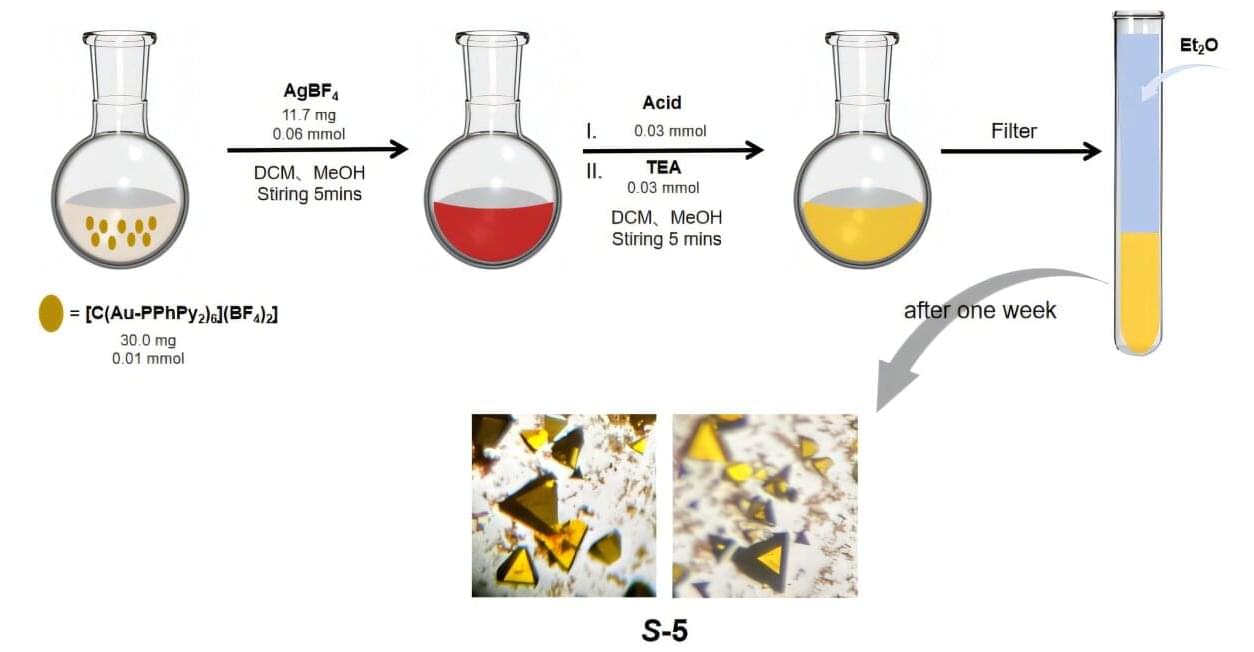
Chiral metal clusters that emit circularly polarized light often face a trade-off between photoluminescence efficiency and luminescence dissymmetry. A study published in the journal Advanced Optical Materials tested whether highly luminescent racemic carbon-centered gold(I)-silver(I) clusters could be converted into bright CPL emitters by enantioresolution with chiral donor ligands.
Researchers have shown that treating highly luminescent but racemic carbon-centered gold(I)-silver(I) clusters with chiral oxygen-donor ligands can separate them into mirror-image forms (enantiomers) that retain strong photoluminescence while gaining the ability to emit circularly polarized light.
A phosphate-protected enantiomer pair achieved a photoluminescence quantum yield of 0.92÷0.93 and the largest luminescence dissymmetry factor (|glum | = 0.008) among the clusters tested. Incorporating the cluster into a composite device with a cholesteric liquid crystal raised the measured device-level |glum | to 1.25.