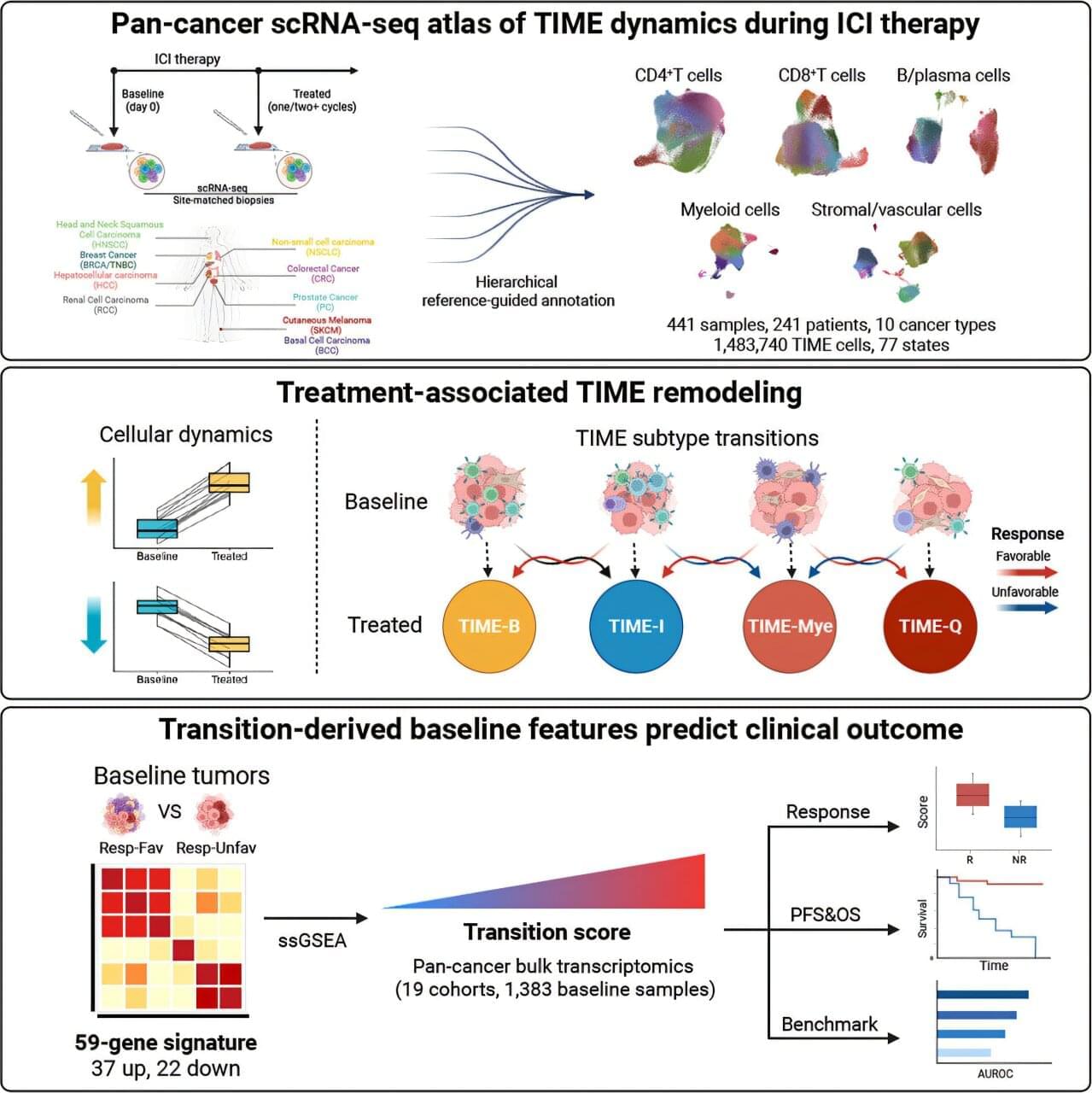
Two patients receive the same immunotherapy for the same cancer. In one, the tumor retreats and stays gone for years. In the other, the treatment does nothing. Oncologists still have no reliable way to tell these patients apart before therapy begins. Why does immunotherapy succeed for some and fail for others?
A new study led by Professor Dvir Aran of the Technion Faculty of Biology and the Henry and Marilyn Taub Faculty of Computer Science, together with first author Dr. Zhongyang Lin and collaborators including Professor Jürgen C. Becker of the German Cancer Consortium (DKTK), offers a new way to think about that question. Its central message: The answer may depend less on how a tumor looks before treatment begins than on how it changes during the first weeks of therapy. The findings are published in the journal Cancer Cell.
At the center of the study is the tumor microenvironment, the complex ecosystem of immune cells, blood vessels and structural cells that surround and interact with the tumor. This environment can either support the immune system’s attack or suppress it, and researchers have long suspected it plays a major role in whether immunotherapy succeeds or fails.