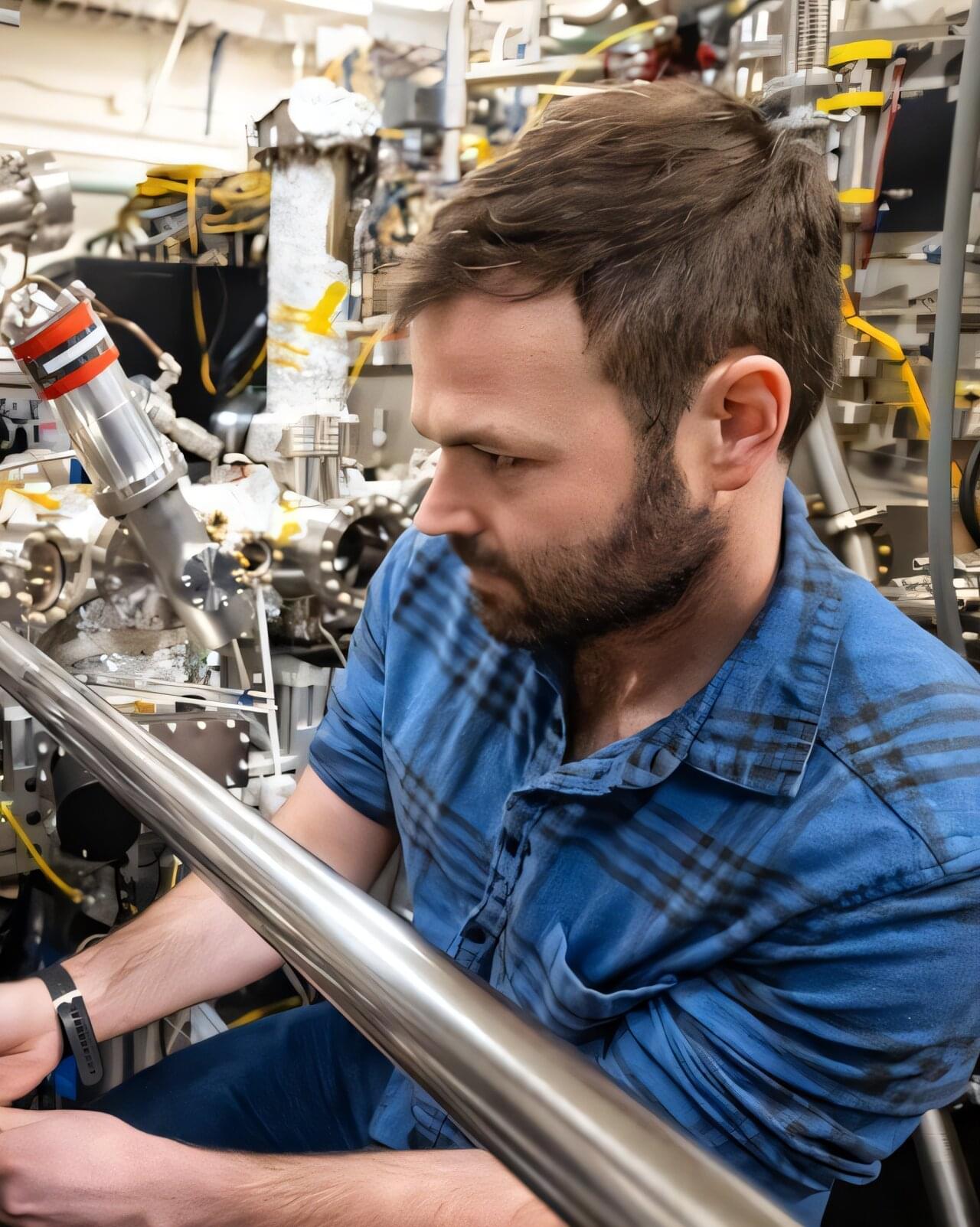
Cornell physicists have discovered that minimizing disorder, not varying electron count, is the key factor for controlling superconductivity in the unique material iron selenide (FeSe), a new insight for understanding high-temperature superconductors.
Using a new technique to control this iron-based superconductor, researchers in Kyle Shen’s lab have found that iron selenide’s superconducting “dome”—the curve tracing how superconductivity strengthens and then weakens as the properties are tuned—is more closely linked to resistance caused by imperfections in its crystal lattice than to the number of electrons flowing through the crystal. Iron selenide could be fundamentally different from other high-temperature (or unconventional) superconductors, the finding suggests.
“We found that in this material, that dome is driven by factors much different than what you see normally,” said postdoctoral researcher Paul Malinowski, a former Klarman Postdoctoral Fellow in the College of Arts and Sciences (A&S). “It’s not driven by how many electrons you’re adding in, but rather, it’s driven by the obstacles the electrons are hitting—how perfect or imperfect is the crystal lattice?”