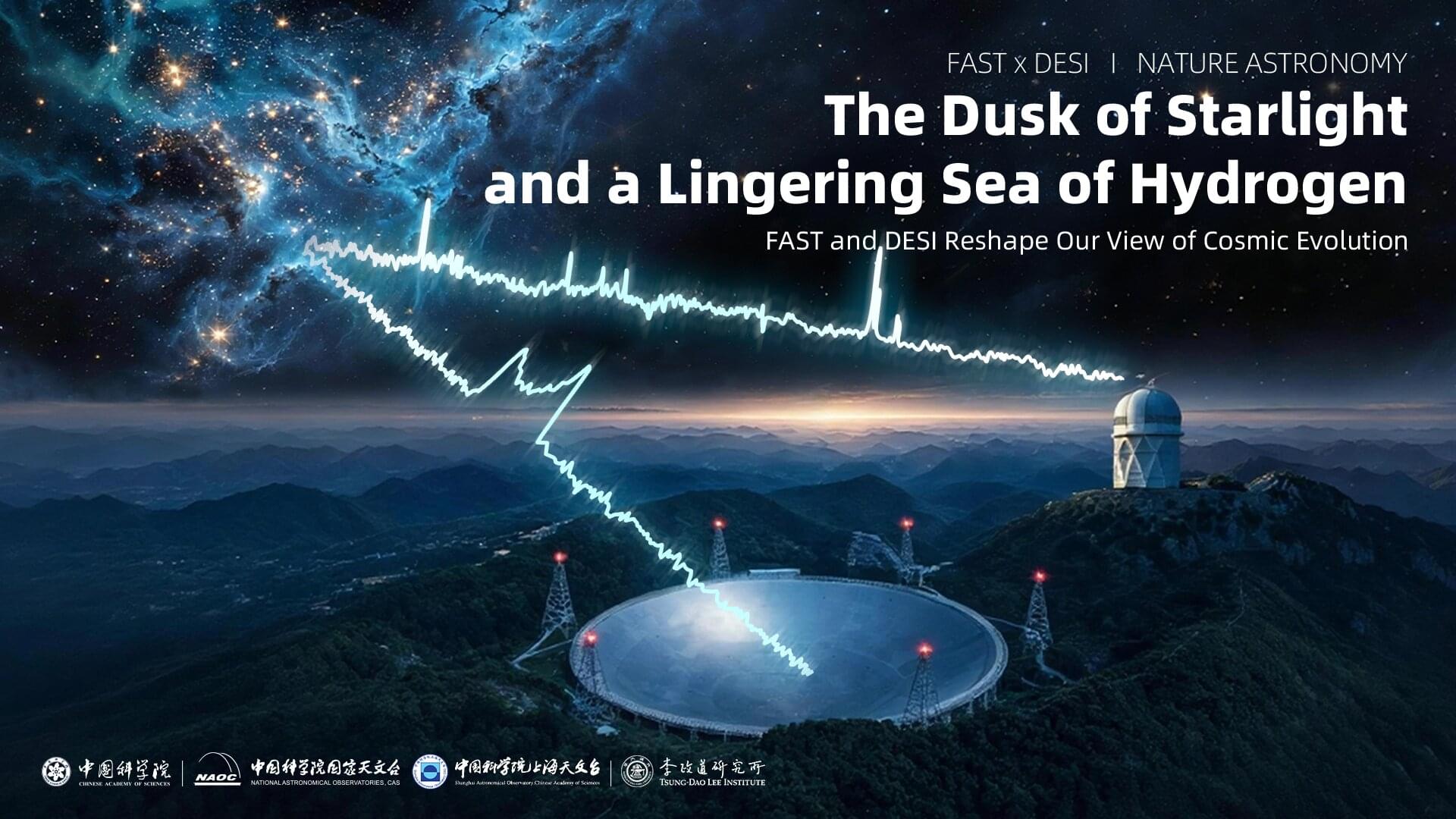
The universe has been having fewer and fewer stellar “babies.” Over the past 4.5 billion years, the rate of star birth has crashed to less than half of what it once was. But here’s the twist: the most essential “fuel” for making stars has barely decreased.
This finding comes from an international team led by researchers from the Chinese Academy of Sciences (CAS), in collaboration with the Dark Energy Spectroscopic Instrument (DESI) project. They used China’s Five-hundred-meter Aperture Spherical radio Telescope (FAST) to make high-precision measurements of cosmic neutral atomic hydrogen over the past 4.5 billion years.
The study reveals that while cosmic star formation has declined dramatically over this period, neutral atomic hydrogen (HI)—a vital gas reservoir for galaxies—has decreased only slightly.