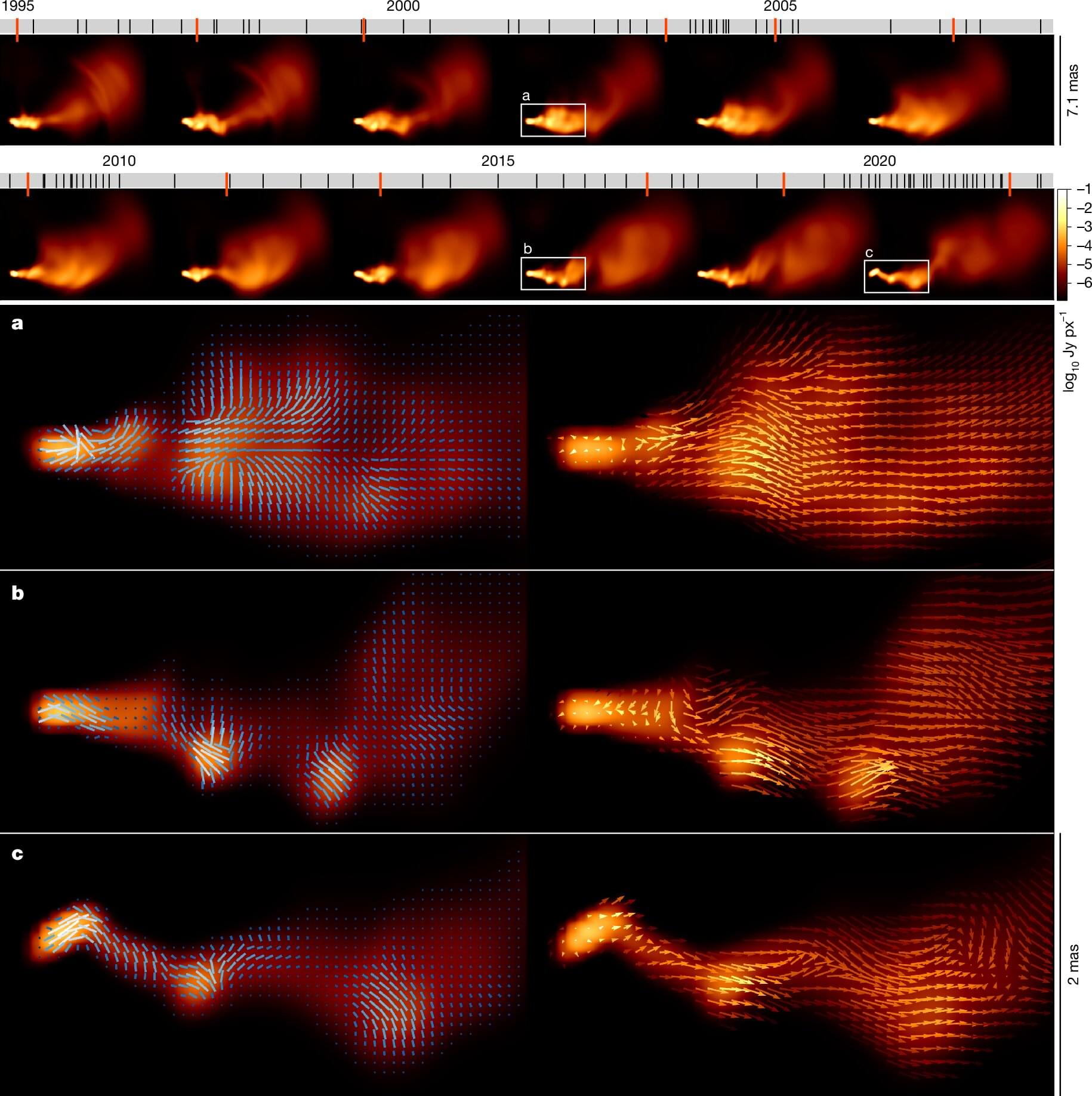
For years, scientists have relied primarily on radio imaging from techniques like very long baseline interferometry (VLBI) to study jets from the active galactic nuclei of supermassive black holes. This allows for the detection of broad, unresolved features, called components, moving at what appear to be faster-than-light speeds. However, traditional imaging has poor resolution and treats each observation as a separate snapshot in time, limiting information about how the features move.
Astronomers have overcome this issue, but only to a degree, by reconstructing unknown aspects with the help of algorithms. Newer modeling methods can sharpen static radio images, but dynamic imaging has remained difficult, especially across large monitoring datasets. But now, a team of researchers has developed an AI-based method that turns scattered radio observations into a continuous, polarized video.
Their new study, published in Nature, applies this method to blazar 3C 345, a type of energetic active galactic nucleus, and the results have upended their understanding of the blazar.