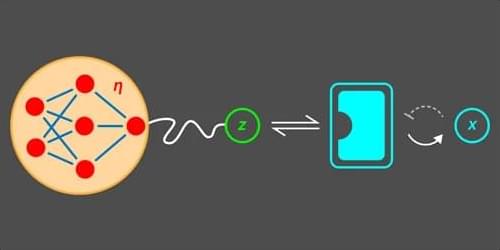
A new model shows how cells could optimize biochemical sensing by balancing information gained against energy spent.
A cell never senses its environment directly. Instead, it receives a noisy stream of molecular cues—chemical markers binding to receptors, enzymes switching states, and messenger molecules appearing and disappearing. Extracting a meaningful signal from these fluctuations can improve survival, but doing so comes at a cost. Maintaining chemical currents and producing readout molecules consume energy. Giorgio Nicoletti of the Abdus Salam International Center for Theoretical Physics in Italy and his colleagues now show how achieving optimal sensing performance requires a balance between gained information and spent energy [1]. Their key idea is to formulate this balance in terms of quantities that can be estimated from statistical observations rather than from hard-to-measure microscopic forces.