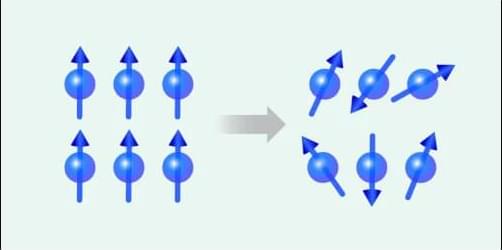
Contrary to expectations, the magnetization dynamics of a ferromagnet can be accelerated by increasing temperature, laser excitation, or magnetic field—a behavior that holds promise for high-speed spintronics.
The ability to control the spins of electrons has given rise to the field of spintronics, opening the door to faster, more energy-efficient electronics exploiting the spin degree of freedom of electrons rather than their electrical charge. However, controlling spin in real devices is still slower than controlling charge in conventional electronics. In the past 30 years, femtosecond light pulses have emerged as a promising means of rapid control in spin-based electronics. A magnetic material responds to external excitation most strongly when the system nears its phase-transition temperature. Unfortunately, that’s also where the response decelerates drastically—a phenomenon known as critical slowing down [1–3].