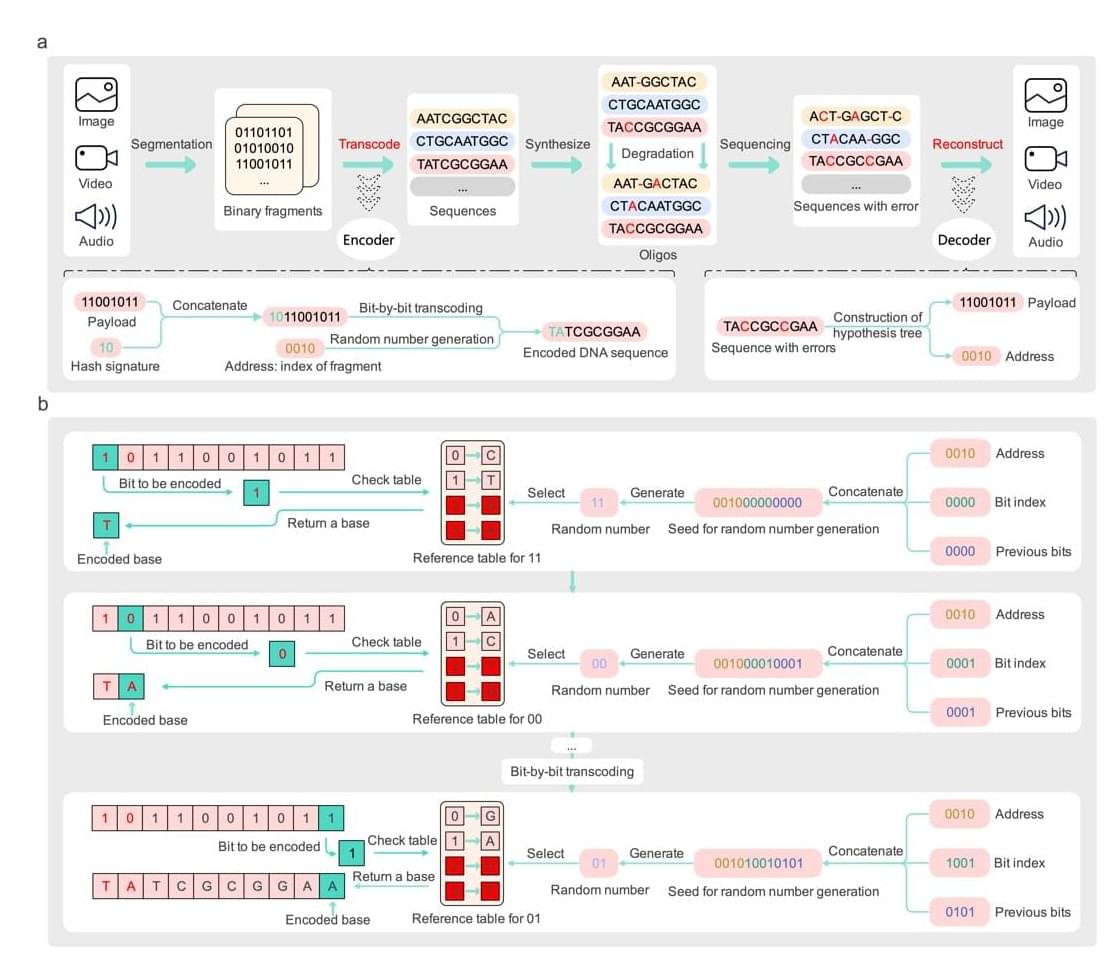
A research team at the Faculty of Engineering at The University of Hong Kong (HKU), led by professor Ruibang Luo of the School of Computing and Data Science and professor Can Li of the Department of Electrical and Computer Engineering, has developed Gungnir, a blockchain-inspired DNA data storage codec. The framework improves digital information recovery from severely damaged DNA sequences, potentially extending the practical lifespan of DNA data archives from less than a decade to centuries. The paper is published in the journal Nature Communications.
DNA is a promising medium for long-term archival storage. It can hold vast amounts of information in a small physical volume, remain stable for millennia under suitable conditions and require no energy during storage. However, DNA molecules can gradually degrade and accumulate damage over time, making the original files increasingly difficult to recover. Existing codecs work best with newly synthesized DNA. They are less effective at correcting errors that build up during long-term storage.
Gungnir takes a new approach to error correction by applying blockchain-based computing techniques to DNA data storage. It uses substantial computing power to generate possible reconstructions of the original data and verify them until it identifies the correct information. In other words, greater computing power gives Gungnir stronger error correction capabilities. The design enables a DNA drive to tolerate error rates of up to 20%, a fourfold improvement over existing methods.