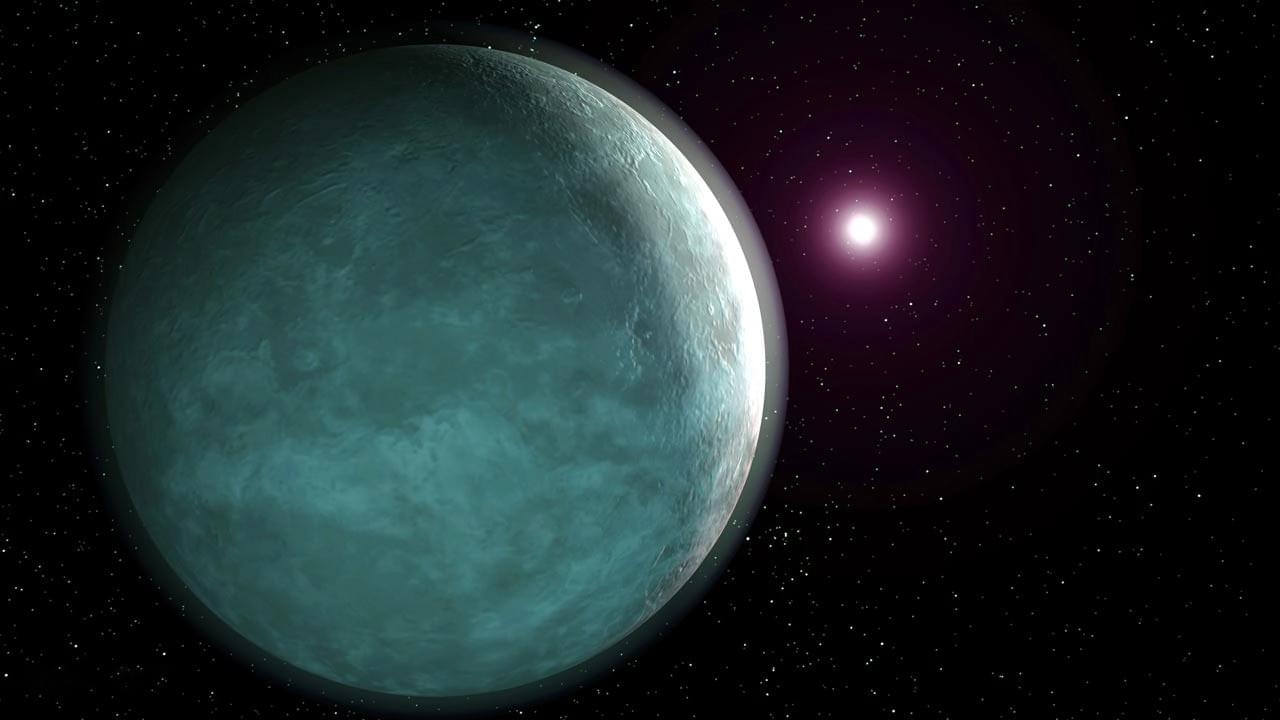
Exoplanet GJ 3,090 b’s “backwards” orbit challenges current theories, suggesting it formed from a misaligned dust disk rather than violent collisions. [ https://www.labroots.com/trending/space/31093/backwards-orbi…theories-2](https://www.labroots.com/trending/space/31093/backwards-orbi…theories-2)
What can a backwards orbiting exoplanet teach astronomers about the formation and evolution of exoplanets? This is what a recent study published in Astronomy and Astrophysics hopes to address as a team of scientists investigated a new type of exoplanet that defies longstanding theories. This study has the potential to challenge longstanding models about the formation and evolution of exoplanets and what this could mean for finding life beyond Earth.
For the study, the researchers examined the exoplanet GJ 3,090 b, which is a Neptune-like exoplanet orbiting an M-type star about 73 light-years from Earth and whose radius and mass are about 2.2 and 4.5 of Earth, respectively. M-type stars are smaller and cooler than our Sun, and what makes GJ 3,090 b unique is it is the first discovered exoplanet orbiting an M-type star whose orbit is the opposite of the star’s rotation, also known as a retrograde planet.
While retrograde planets have been found to occur from the gravitational tug from another star or another larger planet. However, the researchers found no evidence of either being responsible for GJ 3,090 b’s unusual orbit, and they propose that GJ 3,090 b’s orbit could have originated early in its system’s history from a second disk of gas and dust whose orientation was different than the first disk.