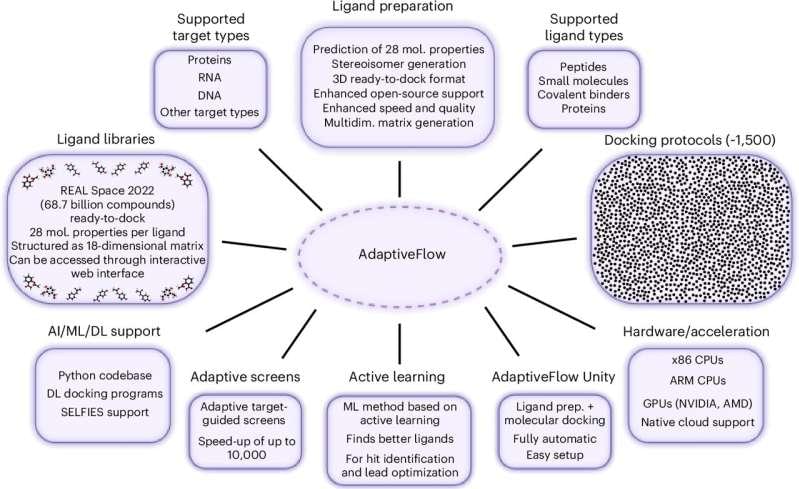
Researchers today announced AdaptiveFlow, an AI-informed platform that can virtually screen billions of drug-like molecules with a 1,000-fold reduction in computational costs over existing methods. Developed and validated by scientists from St. Jude Children’s Research Hospital, University of Pavia, Dana Farber Cancer Institute and Harvard Medical School, AdaptiveFlow allows prohibitively expensive ultra-large virtual drug screens to be conducted routinely. The open-source platform was published today in Nature Biotechnology.
The platform’s framework demonstrated linear scaling up to 5.6 million virtual central processing units (CPUs)—a new benchmark for cloud-based drug discovery—allowing billions of molecules to be screened without loss of efficiency. As proof of concept, the team identified potent inhibitors for existing and emerging cancer targets for which few inhibitors are known.
“AdaptiveFlow is the next generation in automated drug discovery platforms for routine ultra-large virtual screenings,” said co-corresponding author Christoph Gorgulla, Ph.D., Center of Excellence for Data-Driven Discovery, St. Jude Department of Structural Biology. “With this platform, we are able to screen 69 billion molecules, representing the largest ready-to-dock library in the world.”