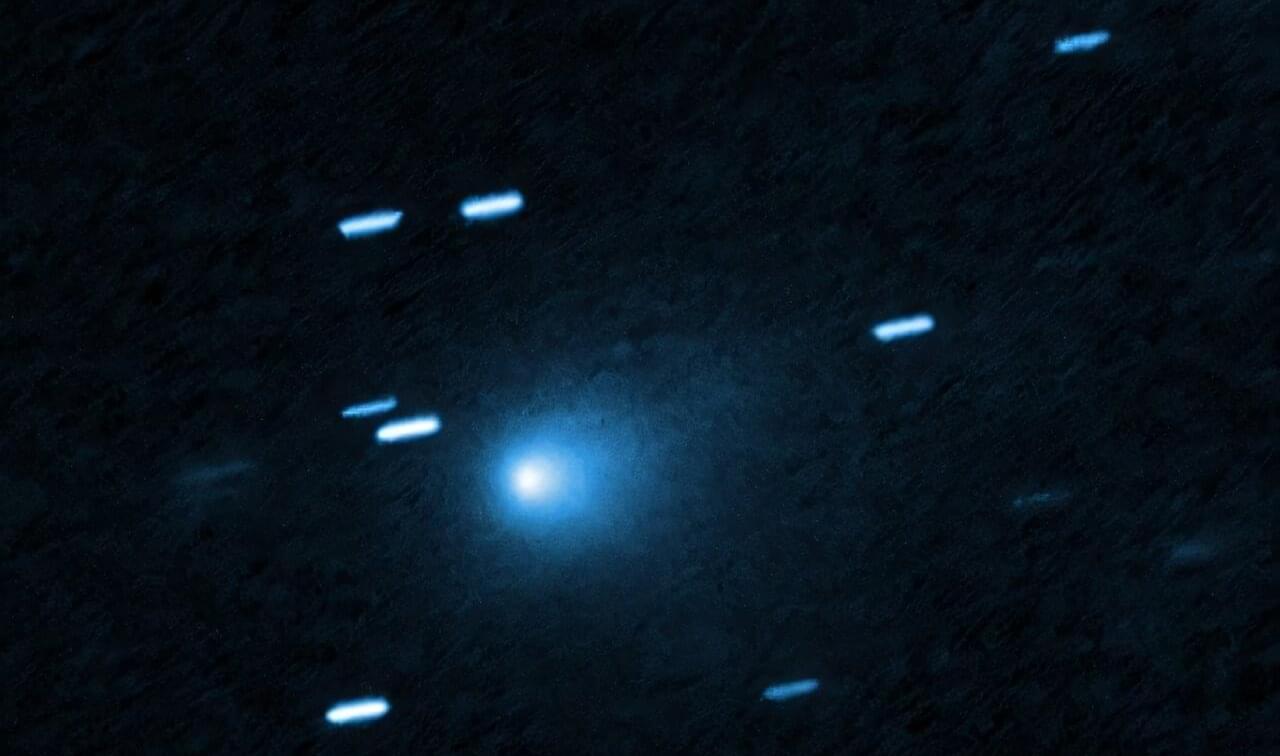
I still don’t know what this is because there has been too much propaganda.
More and more details about 3I/ATLAS are filtering through the scientific process as time goes on. Our third known interstellar visitor attracted the attention of some of the world’s most powerful observatories when it was discovered in July 2025, and some of those telescopes found something peculiar—the isotopes it contained appeared different. A new paper submitted to The Astrophysical Journal Letters (and available as a preprint on arXiv) by Kenji Furuya of the RIKEN Pioneering Research Institute in Japan and his co-authors shows that the isotopic discrepancy is likely due to the “low metallicity” of the stellar nursery in which 3I/ATLAS was born.
In everyday language, we think of metals as having certain properties. But to astronomers, “metals” include anything with an atomic number higher than helium that was created in supernovae after the first generation of stars died. Hence, the universe has slowly become more metallic over time, at least according to astronomical standards, as more and more stars explode in supernovae and create “crazier space dust,” as a famous YouTube video once put it.
Some of that crazier space dust takes the form of carbon, which is crucial in organic chemistry but also present in 3I/ATLAS. Critically, it was present in an isotope ratio that didn’t match anything seen in our own solar system. The ratio of C-12 (i.e., a carbon atom with 12 protons and neutrons) to C-13 (a carbon atom with one more neutron) for objects in our solar system hovers around 90. The ratio for the interstellar medium averages around 68. In 3I/ATLAS, that ratio was between 123 and 191—much higher than anywhere the interstellar object has been traveling in the past few billion years.