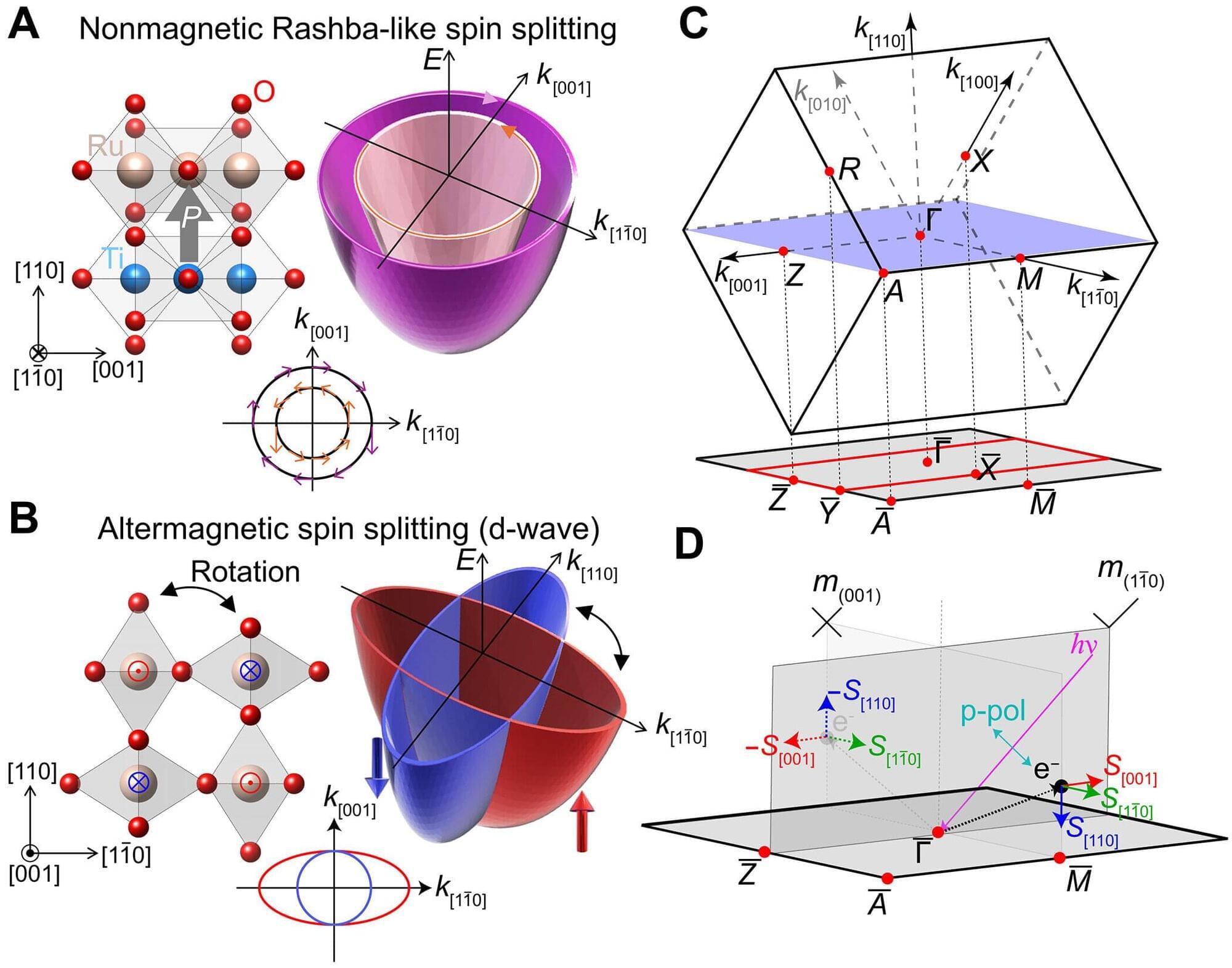
Ruthenium dioxide (RuO2) is a metal oxide that commonly serves as an important metallic conductor, quantum material and industrial electrocatalyst. While there have been debates surrounding the magnetic properties of RuO2, it is generally thought to be nonmagnetic in its bulk form. But now, a new study, published in Science Advances, has found that very thin layers of RuO2 can become magnetic when its lattice is placed under strain.
RuO2 is known for its unusual magnetic properties, which have led some researchers to propose that it may be an altermagnet —a material with magnetic order but little or no overall magnetization. Most previous studies have examined bulk RuO2 crystals or thicker, relaxed films and have reported conflicting findings on magnetic order. Earlier studies linked RuO2 to magnetic order, unusual Hall effects and efficient spin-charge conversion, while later studies found no magnetic order in bulk or relaxed films.
While one study reported the absence of altermagnetic properties down to 5 nanometers of RuO2 thickness, a fully strained ultrathin regime below about 4 nanometers had not been directly studied with both momentum and spin resolution.