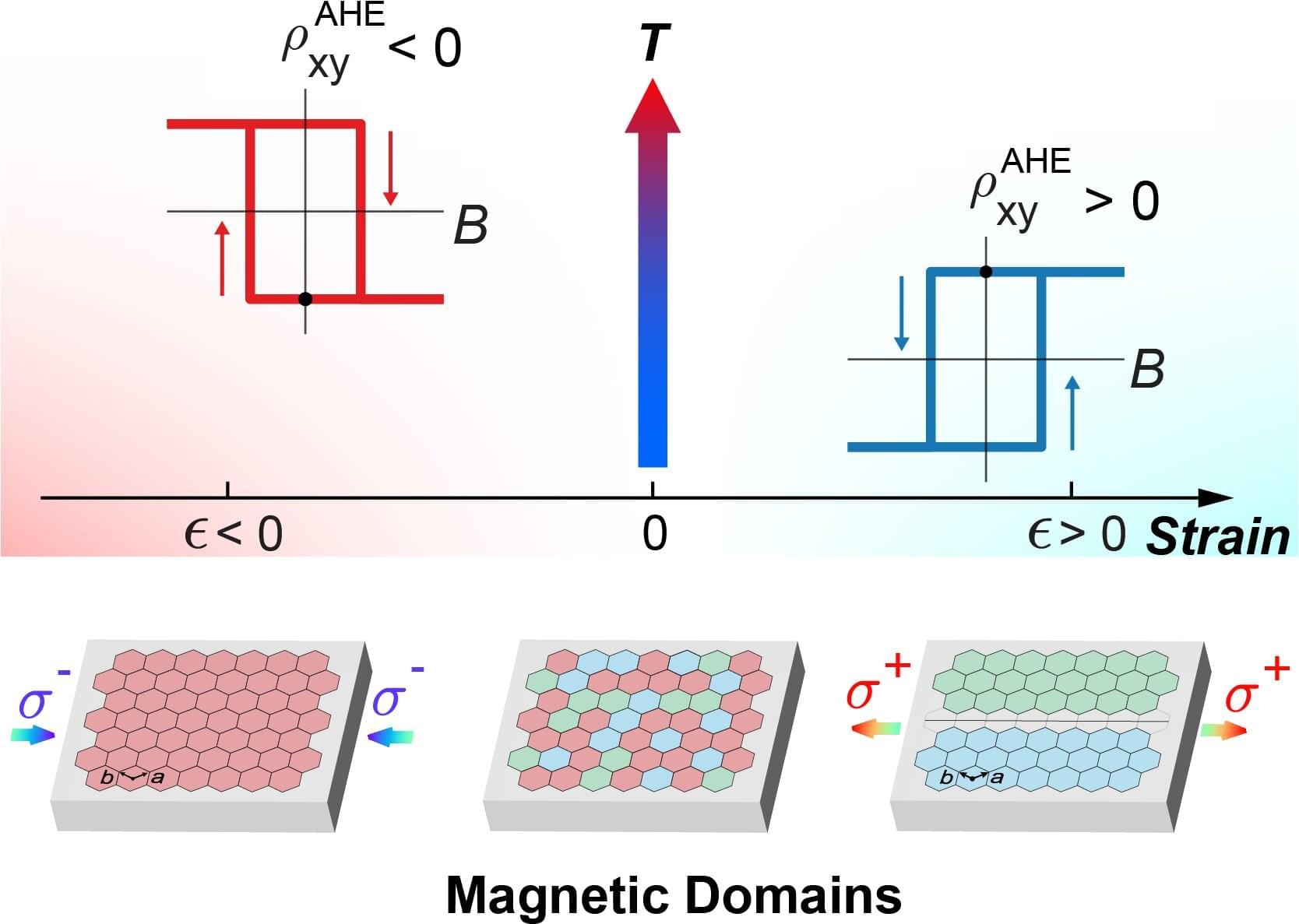
Altermagnetism is a new, third type of magnetism of great interest for spin-transport applications like computer memory. If properly harnessed, it could combine the benefits of the two existing types of magnetism, ferromagnetism and antiferromagnetism, ultimately reducing or eliminating heat during information transfer and increasing the ability to miniaturize next-generation technologies. Rice University’s Pengcheng Dai recently published a paper in Physical Review X describing the first successful efforts to put a proposed altermagnetic material into a single magnetic-domain state, allowing the research team to characterize the material’s intrinsic magnetic structure.
“Altermagnets like hexagonal manganese telluride typically form multidomain structures where the magnetic forces divide into separate equivalent domains that spin in different directions to satisfy the underlying threefold rotational symmetry of the hexagonal lattice,” said Dai, the Sam and Helen Worden Professor of Physics and Astronomy.
“The signals from these coexisting domains could overlap, making it hard to know what the underlying magnetic structure actually is. Here, we were able to apply a uniaxial strain, which resulted in a single magnetic domain we could clearly resolve into the underlying magnetic structure.”